
What to do when a student is “parked” in your maths lesson
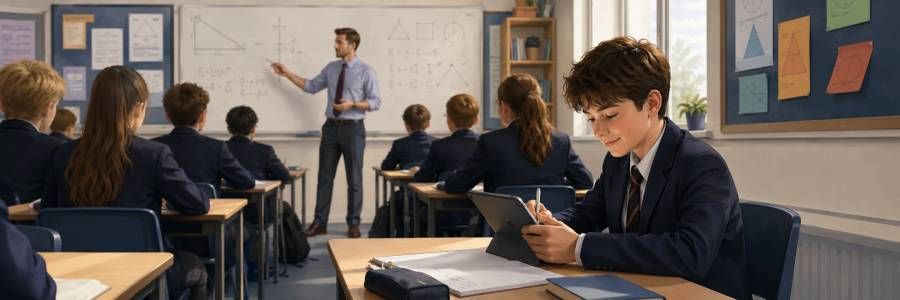
Most teachers will recognise the situation.
You are halfway through teaching your own class when another student appears at the door. They have been sent to your lesson for a while — “parked”, “removed”, “relocated”, or whatever terminology your school happens to use.
You may know why they are there.
Quite often, you do not.
Recently, I had a Year 7 student from another class placed in one of my lessons. I did not know him and had not been given any work for him. Meanwhile, I still had my own class to teach.
It would have been very easy for the next hour to become dead time for him.
Instead, I lent him my iPad and opened a self-marking ESHEETS multiplication worksheet.
Leave the story at the door
When a student is removed from another lesson, it is tempting to make assumptions.
Perhaps they were disruptive. Perhaps they refused to work. Perhaps they were rude to a member of staff.
Or perhaps the situation was more complicated.
Unless I have actually been given the details, I try not to invent them.
The student arriving in my classroom is simply the student in front of me.
That does not mean ignoring behaviour systems or undermining colleagues. If a student has been removed from a lesson, there may have been a very good reason for it.
But there is little educational value in silently deciding that a child you have never met is “trouble” before they have even sat down.
A fresh room and a fresh adult can sometimes provide a useful reset.
Start with a low entry barrier
My first choice for this particular student was multiplication tables.
There was a practical reason for that.
I knew almost nothing about his maths attainment, and I was already teaching another class. I did not have time to carry out an informal diagnostic interview or construct a personalised learning plan before he had taken his coat off.
Multiplication tables gave me a low entry barrier.
They also told me something.
Within a few minutes, I could get a rough sense of his fluency, confidence and willingness to engage. Most importantly, he could start the work immediately.
The worksheet generated the questions. He entered his answers. The page marked them automatically.
I did not need to interrupt my teaching every thirty seconds to confirm whether 7 × 8 was 56.
When he had completed the work, he raised his hand and showed me.
That was my opportunity to check in.
Move sideways, then slightly upwards
The multiplication work had gone well, so I wanted to give him something more demanding.
I chose expanding a single bracket.
There was a connection between the two activities. His multiplication fluency was still useful, but the algebra added another layer of thinking.
This time he needed a small amount of verbal guidance.
I explained the basic idea and worked through enough to get him started. Then I returned to my own class.
A little later, I checked back.
He had got it.
Not “he had completed the page by randomly pressing buttons until enough green boxes appeared”.
He actually seemed to understand what he was doing.
Better still, he was visibly pleased with himself.
The worksheet had awarded him the Perfect Panda 🐼 badge, which apparently carried rather more emotional significance than my carefully considered professional feedback might have done.
Fair enough.
Independent maths work does not have to mean pointless work
The difficulty with a parked student is that your main responsibility has not disappeared.
You still have your own lesson to teach.
A task that requires ten minutes of explanation, constant checking and individual marking may simply transfer the disruption from one classroom to another.
That is where self-marking maths worksheets can be particularly useful.
A student can begin work with minimal setup, receive immediate feedback and correct mistakes without waiting for a teacher. The teacher can then check in at sensible moments rather than hovering over the student continuously.
In my case, I was able to continue teaching my lesson while the student completed genuine maths work on the same iPad.
When he raised his hand, I knew there was something useful for us to discuss.
The technology had not replaced me as a teacher.
It had removed a lot of the unnecessary administrative friction around the teaching.
Ask: what can this work tell me?
The experience reinforced something I increasingly value when choosing independent maths work.
Do not just ask:
What can I give this student to keep them busy?
Ask:
What can I give them that will tell me something?
A short piece of accessible work can reveal a great deal.
Are they fluent with basic number facts?
Do they read questions carefully?
Do they persist after an incorrect answer?
Can they apply a short verbal explanation independently?
Are they ready to move onto something harder?
In this case, multiplication tables gave me a starting point. Expanding brackets gave me a sensible next step.
Because the worksheets were self-marking, I could make those decisions from brief check-ins rather than taking over the student's entire hour.
Success can change the tone of the situation
It is worth remembering what being removed from a lesson may feel like from a student's point of view.
Even when the removal is entirely justified, the student may arrive defensive, embarrassed or expecting another confrontation.
Giving them work that is impossibly difficult or obviously meaningless is unlikely to improve matters.
A small, genuine success can change the tone.
This Year 7 student started with multiplication questions he could access. He then moved onto an algebra topic that initially required some help.
By the end, he had learned something.
He knew that he had learned something.
And, thanks to a cartoon panda 🐼, he had also been given a small digital celebration of the fact.
A potentially negative hour had become a positive one.
I am not claiming that a self-marking worksheet will solve behaviour problems, transform school removal systems or cause every parked student to undergo a dramatic mathematical awakening.
That would be a rather ambitious feature list.
But it did give me a practical way to keep one student learning without disrupting the lesson I was already teaching.
Sometimes “useful” is a perfectly good outcome
Teachers are often encouraged to plan elaborate interventions, personalised pathways and carefully differentiated learning experiences.
There is a place for all of that.
There is also a place for recognising the reality of a busy classroom.
I had an unfamiliar Year 7 student appear during my lesson with no work.
I needed something useful, immediate and manageable.
He practised multiplication.
He learned how to expand brackets.
He experienced some success.
I continued teaching my class.
Under the circumstances, I will happily take that as a win.
ESHEETS includes a growing library of free, self-marking maths worksheets that students can use on an iPad, Chromebook or computer. Students receive immediate feedback as they work, making the worksheets useful for independent practice, homework and revision.
And, occasionally, they are useful because a Year 7 student you have never met has just appeared at your classroom door.