
Simple interest calculations
Whether you're saving money in a bank or borrowing for a new phone, simple interest helps you work out how much extra money is gained or owed over time. In the real world it's not quite as useful as compound interest, but it's nevertheless a skill that you need to know to make everyday money decisions. Jump to the questions
Practise now
Worksheet preview and key skills
Worksheet preview
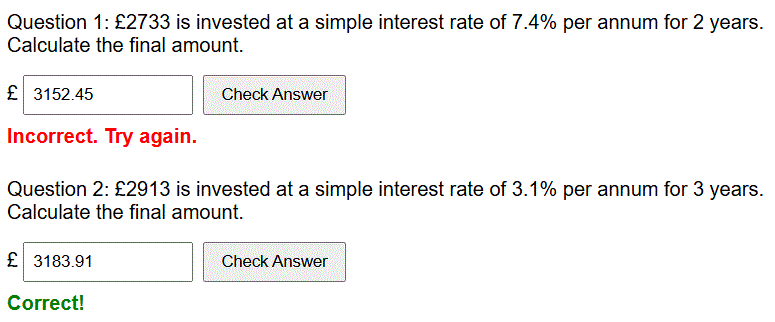
Practise simple interest calculations with this self-marking maths worksheet.
The interactive worksheet below generates questions, gives instant feedback, and lets students record their score.
What you’ll practise
- Identifying the principal, rate and time.
- Calculating interest for one year or several years.
- Using percentage rates correctly.
- Finding the final amount after interest is added where needed.
Use the interactive worksheet below, or read the Topic guide for the method and worked example.
Calculate the final amount using simple interest. Since it's money, round your answer to two decimal places!
Topic guide
What this worksheet practises
This worksheet focuses on Simple Interest. In Simple Interest, the amount of money you earn (the interest) is calculated once on the original starting amount, and you earn that exact same flat cash amount every single year. (This is different from Compound Interest, where the amount grows faster every year).
Key method
Calculating simple interest is a straightforward percentage calculation multiplied by time.
- Identify the starting amount (the Principal), the Interest Rate percentage, and the Time (in years).
- Calculate what the Interest Rate percentage is in real money (e.g., what is 5% of the starting amount?). This gives you the Interest for 1 year.
- Multiply this "1 year" amount by the total number of years the money is invested. This gives the Total Interest Earned.
- If the question asks for the "Total Amount in the Bank", you must add your Total Interest back onto the original starting amount.
Worked example
£400 is invested in a bank account for 3 years at a simple interest rate of 5% per year. Calculate the total amount in the account at the end of the 3 years.
Step 1: Find the interest for 1 year.
5% of £400. (10% is 40, so 5% is 20).
The bank pays £20 every year.
Step 2: Calculate the total interest for 3 years.
£20 × 3 years = £60 total interest.
Step 3: Find the final total in the account.
Original £400 + £60 interest = £460.
The final amount is £460.
Common mistakes to avoid
The most common mistake is stopping after calculating the total interest (£60 in the example above) and forgetting to add it back to the original amount to find the final bank balance. Always read the final sentence of the question carefully to see if it asks for "Total Interest" or "Total Amount".
How to check your answer
With simple interest, the growth is linear. If your starting amount is £1000 and the rate is 4%, it will go up by £40 exactly, every single year (£1040, £1080, £1120). If your final answer seems much too large, you might have accidentally calculated compound interest instead.