
Simplifying ratios worksheet
Ratios are everywhere—from mixing paint colors to adjusting a recipe in the kitchen. Simplifying ratios helps us compare quantities more easily by reducing them to their simplest form, just like simplifying fractions. Whether you're scaling up a model or splitting costs with friends, knowing how to simplify ratios makes problem-solving much more efficient! Jump to the questions
Practise now
Worksheet preview and key skills
Worksheet preview
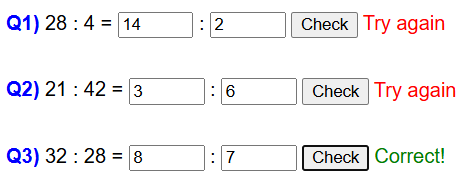
Practise simplifying ratios with this self-marking maths worksheet.
The interactive worksheet below generates questions, gives instant feedback, and lets students record their score.
What you’ll practise
- Finding a common factor in the ratio parts.
- Dividing each part by the same number.
- Writing the ratio in its simplest form.
- Checking the parts are still in the same proportion.
Use the interactive worksheet below, or read the Topic guide for the method and worked example.
Simplify the given ratios fully.
Topic guide
What this worksheet practises
This worksheet provides practice on simplifying ratios. Similar to simplifying fractions, the goal is to make the numbers in the ratio as small as possible while keeping their relative sizes exactly the same.
Key method
You must divide both sides of the ratio by the same number.
- Look at the numbers in the ratio (e.g. 15 : 20).
- Find the "Highest Common Factor" – the biggest number that divides exactly into both sides without leaving a remainder.
- Divide both sides of the ratio by this number.
- Check your new ratio. Can it be divided again? If so, keep dividing until no more common factors can be found.
Worked example
Simplify the ratio 24 : 36.
Step 1: Find a number that divides into both 24 and 36. You might spot that they are both in the 12 times table.
Step 2: Divide both sides by 12.
24 ÷ 12 = 2.
36 ÷ 12 = 3.
Step 3: The ratio is now 2 : 3.
Step 4: Check if it can go further. The only number that goes into both 2 and 3 is 1, so it is fully simplified.
The final answer is 2 : 3.
Common mistakes to avoid
A frequent mistake is dividing the two sides by completely different numbers. For example, changing 10 : 15 into 5 : 3 by dividing the left by 2 and the right by 5. You must always perform the exact same mathematical operation on both sides of the colon.
Things to remember
If you cannot find the Highest Common Factor immediately, you can simplify in multiple smaller steps. For 24 : 36, you could halve them to get 12 : 18, halve them again to get 6 : 9, and then divide by 3 to get 2 : 3. You will always reach the same final answer.