
Find missing angles using the sine rule
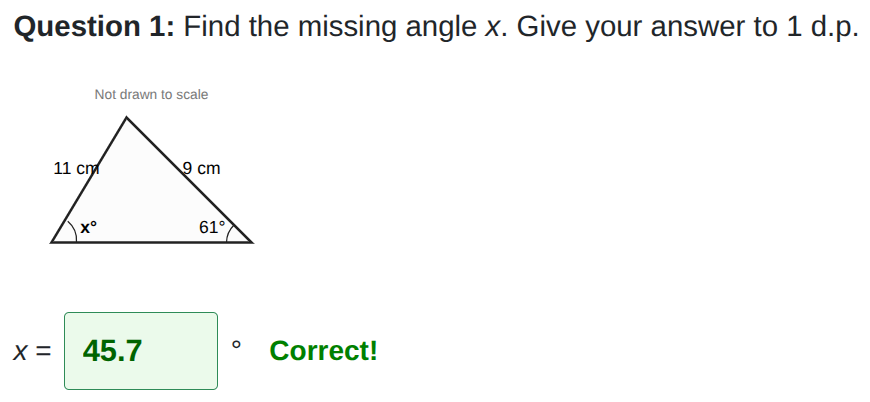
The sine rule lets you calculate unknown angles in any triangle, making it a crucial tool when right-angled trigonometry isn't an option. This is an essential skill for fields like aviation and marine navigation, where calculating the exact turning angle or heading is critical for plotting a safe course. Jump to the questions
Looking for questions on missing lengths with the sine rule?
Practise now
Worksheet preview and key skills
Worksheet preview
Practise the sine rule for missing angles with this self-marking maths worksheet.
The interactive worksheet below generates questions, gives instant feedback, and lets students record their score.
What you’ll practise
- Identifying a matching angle-side pair.
- Choosing the sine rule for missing angles.
- Substituting known values into the sine rule.
- Using inverse sine to find the angle.
Use the interactive worksheet below, or read the Topic guide for the method and worked example.
Topic guide
What this worksheet practises
This worksheet provides practice on using the Sine Rule to calculate a missing angle in any triangle. Because we are looking for an angle, we flip the standard formula upside down. This makes the algebra much easier to solve.
Key method
The flipped Sine Rule for missing angles is: sin(A) / a = sin(B) / b
- Label your triangle: Label the missing angle you want to find 'A', and the side directly opposite it 'a'. Label the known angle 'B', and the side directly opposite it 'b'.
- Write out the flipped formula and substitute your numbers in.
- To isolate 'sin(A)', move the side 'a' from the bottom left across to the top right. It becomes a multiplication.
- Your calculation will look like: sin(A) = (sin(B) / b) × a.
- This gives you the value of sin(A). To find the actual angle 'A', you must use the inverse sine function (sin&supmin;¹) on your calculator.
Worked example
A triangle has a side of 8cm opposite a missing angle 'x'. It has another side of 12cm opposite a known angle of 50°. Calculate angle 'x'.
Step 1: Label and substitute into the flipped formula.
sin(x) / 8 = sin(50) / 12
Step 2: Rearrange to get sin(x) on its own. Multiply both sides by 8.
sin(x) = (sin(50) / 12) × 8
Step 3: Calculate the value of sin(x).
sin(x) = 0.06383... × 8
sin(x) = 0.5106...
Step 4: Use inverse sine (shift-sin on most calculators) to find the angle.
x = sin&supmin;¹(0.5106...)
x = 30.70...
The final answer is 30.7° (to 1 d.p.).
Common mistakes to avoid
The most catastrophic mistake is forgetting the final step. A student will correctly calculate the value of sin(x) as 0.5106 and write that down as their final answer. An angle of 0.5 degrees inside a triangle is almost impossible to draw. You must remember to use sin&supmin;¹ to turn the decimal ratio back into an actual degree measurement.
Things to remember
If you type your calculation into the calculator and it says "Maths ERROR" or "Syntax Error", it means you have made a mistake in your rearrangement, and your value for sin(x) is greater than 1. The sine of an angle can never be larger than 1. Check your fractions and try again.