
Finding missing lengths or sides using the sine rule
The sine rule is a powerful tool that lets you calculate missing distances in any triangle, freeing you from only working with right-angled shapes. It is an essential skill used by surveyors, navigators, and architects to map out real-world spaces when measuring directly isn't possible. Jump to the questions
Looking for questions on missing angles with the sine rule?
Practise now
Worksheet preview and key skills
Worksheet preview
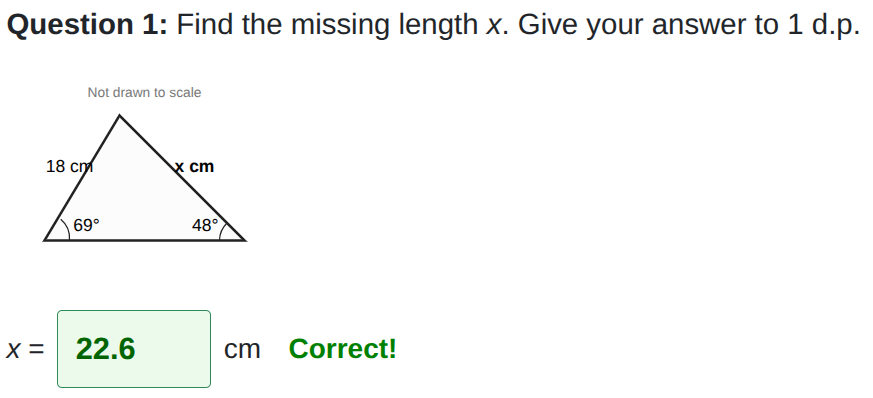
Practise the sine rule for missing lengths with this self-marking maths worksheet.
The interactive worksheet below generates questions, gives instant feedback, and lets students record their score.
What you’ll practise
- Identifying a matching angle-side pair.
- Choosing the sine rule for missing lengths.
- Substituting known values into the sine rule.
- Solving for the missing side.
Use the interactive worksheet below, or read the Topic guide for the method and worked example.
Topic guide
What this worksheet practises
This worksheet focuses on using the Sine Rule to calculate a missing side length in any triangle. Unlike normal trigonometry (SOH CAH TOA), the Sine Rule does not require a right angle. It works by linking sides to the angles directly opposite them.
Key method
The Sine Rule for missing lengths is: a / sin(A) = b / sin(B)
- Label your triangle: Label the missing side you want to find 'a', and the angle directly opposite it 'A'. Label the other side you know 'b', and the angle directly opposite it 'B'.
- Write out the formula and substitute your numbers in.
- To find the missing side 'a', you must isolate it. You do this by moving the 'sin(A)' from the bottom left across to the top right. It becomes a multiplication.
- Your final rearranged calculation will look like this: a = (b / sin(B)) × sin(A).
- Type this into your calculator. Ensure your calculator is in Degrees mode (a small 'D' on the screen).
Worked example
A triangle has an angle of 40° opposite a missing side 'x'. It has another angle of 60° opposite a known side of 10cm. Calculate 'x'.
Step 1: Label and substitute into the formula.
x / sin(40) = 10 / sin(60)
Step 2: Rearrange to get 'x' on its own. Multiply both sides by sin(40).
x = (10 / sin(60)) × sin(40)
Step 3: Calculate the value.
x = 11.547 × 0.6427...
x = 7.422...
The final answer is 7.42cm (to 2 d.p.).
Common mistakes to avoid
The biggest mistake is pairing up the wrong sides and angles. The Sine Rule only works if the side and the angle are directly opposite each other (like an open alligator mouth). If you pair a side with an angle that is touching it (adjacent), the formula will fail completely.
How to check your answer
In any triangle, the longest side is always opposite the largest angle, and the shortest side is opposite the smallest angle. In our example, the angle of 40° is smaller than 60°, so our side 'x' (7.42cm) must be smaller than the other side (10cm). It is, which means our answer is sensible.