
Finding missing angles with the cosine rule
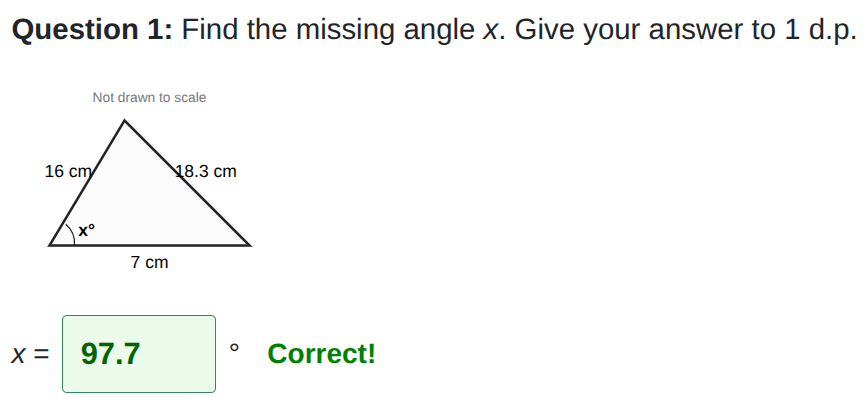
The cosine rule is not just useful for finding missing sides — it can also be rearranged to find missing angles. This is especially helpful in non-right-angled triangles when all three side lengths are known, giving us a reliable method when angle facts or trigonometry for right-angled triangles are not enough. Jump to the questions
Looking for questions on missing sides with the cosine rule?
Practise now
Worksheet preview and key skills
Worksheet preview
Practise the cosine rule for missing angles with this self-marking maths worksheet.
The interactive worksheet below generates questions, gives instant feedback, and lets students record their score.
What you’ll practise
- Identifying when three side lengths are known.
- Rearranging or using the cosine rule for an angle.
- Substituting side lengths carefully.
- Using inverse cosine to find the angle.
Use the interactive worksheet below, or read the Topic guide for the method and worked example.
Topic guide
What this worksheet practises
This worksheet practises using the rearranged cosine rule to calculate a missing angle in a non-right-angled triangle. You use this specific method when you are given the lengths of all three sides of the triangle.
Key method
The rearranged cosine rule for finding an angle is:
cos(A) = (b² + c² − a²) ÷ 2bc
- 'A' is the angle you are trying to find.
- 'a' is the side directly opposite angle A.
- 'b' and 'c' are the other two sides next to the angle.
Once you calculate the value of cos(A), you must use the inverse cosine function, usually written as cos-1 on your calculator, to find the actual angle.
Worked example
Find angle A in a triangle with sides a = 7 cm, b = 5 cm, and c = 8 cm. Give your answer to 1 decimal place.
Step 1: Substitute the values into the formula.
cos(A) = (5² + 8² − 7²) ÷ (2 × 5 × 8)
Step 2: Calculate the numerator and denominator separately.
Numerator: 25 + 64 − 49 = 40
Denominator: 2 × 5 × 8 = 80
Step 3: Divide to find cos(A).
cos(A) = 40 ÷ 80 = 0.5
Step 4: Use inverse cosine to find the angle.
A = cos-1(0.5) = 60°
Common mistakes to avoid
The most common mistake is incorrectly labelling the sides. Side 'a' must always be the side opposite the angle you are looking for. If you mix up 'a' with 'b' or 'c', the subtraction at the end of the numerator will be wrong.