
Find missing lengths using the cosine rule
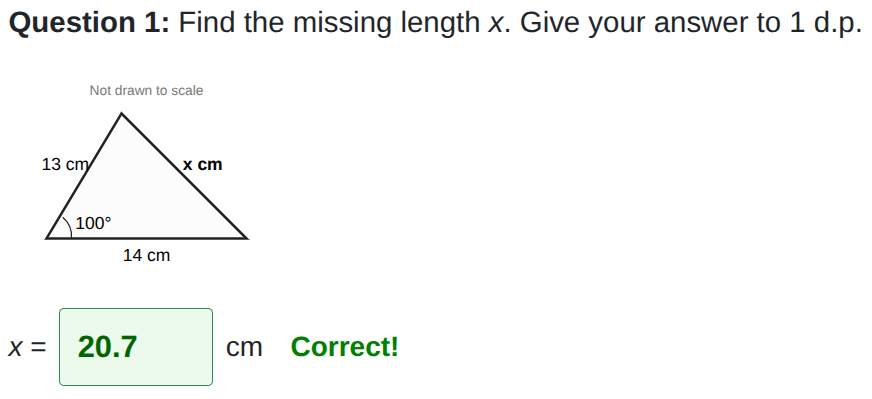
The cosine rule is useful because it lets us find missing lengths in triangles that are not right-angled, where Pythagoras cannot be used. It is especially helpful when we know two sides and the angle between them, and it appears in many real-life problems involving distances, bearings, construction, design and navigation. Jump to the questions
Looking for questions with missing angles and the cosine rule?
Practise now
Worksheet preview and key skills
Worksheet preview
Practise the cosine rule for missing lengths with this self-marking maths worksheet.
The interactive worksheet below generates questions, gives instant feedback, and lets students record their score.
What you’ll practise
- Identifying when two sides and the included angle are known.
- Choosing the cosine rule for a missing length.
- Substituting values into the cosine rule.
- Square-rooting to find the missing side.
Use the interactive worksheet below, or read the Topic guide for the method and worked example.
Topic guide
What this worksheet practises
This worksheet practises using the cosine rule to find a missing side length in any non-right-angled triangle. You use this rule when you know the lengths of two sides and the size of the angle trapped between them (the included angle).
Key method
The cosine rule for finding a missing length is:
a² = b² + c² − 2bc cos(A)
- 'a' is the missing side you want to find.
- 'A' is the angle opposite side 'a'.
- 'b' and 'c' are the other two known sides.
Substitute your known values into the right-hand side of the equation, calculate the result, and then take the square root to find 'a'.
Worked example
Find the length of side x in a triangle where the other two sides are 5 cm and 8 cm, and the angle between them is 60°.
Step 1: Label the sides and angle. Let a = x, b = 5, c = 8, and A = 60°.
Step 2: Substitute into the formula.
x² = 5² + 8² − (2 × 5 × 8 × cos(60°))
Step 3: Calculate the parts.
x² = 25 + 64 − (80 × 0.5)
x² = 89 − 40
x² = 49
Step 4: Take the square root to find x.
x = √49 = 7 cm
Common mistakes to avoid
A frequent error is forgetting the final step of taking the square root of the answer. If you calculate a² as 49, the length is not 49 cm; you must take the square root to get 7 cm.
Things to remember
Ensure your calculator is set to degrees (usually shown as a 'D' or 'Deg' on the screen) before working out trigonometric questions, or your answers will be incorrect.