
Solving equations with unknowns on both sides
Equations with unknowns on both sides (also known as "split variables") are useful because they help you solve problems where two expressions are being compared. This skill appears in many GCSE algebra topics, including forming equations from worded problems, working with angles, perimeter, area, sequences and graphs. The main idea is simple: collect the x terms together, collect the numbers together, and keep the equation balanced at every step. Jump to the questions
Practise now
Worksheet preview and key skills
Worksheet preview
Practise solving equations with unknowns on both sides with this self-marking maths worksheet.
The interactive worksheet below generates questions, gives instant feedback, and lets students record their score.
What you’ll practise
- Collecting unknown terms onto one side.
- Collecting number terms onto the other side.
- Using inverse operations.
- Checking in the original equation.
Use the interactive worksheet below, or read the Topic guide for the method and worked example.
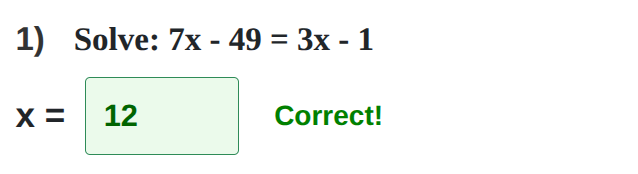
Solve the following linear equations to find the value of x.
Topic guide
What this worksheet practises
This worksheet helps you build confidence in solving linear equations where the unknown variable (usually x) appears on both sides of the equals sign. You will start with equations that have positive coefficients, before progressing to equations involving negative coefficients.
Key method
The main goal is to collect all the x terms on one side of the equation and all the number terms on the other side. This is achieved by doing the exact same operation to both sides of the equation to keep it balanced.
To keep things simple, it is often best to move the smaller x term towards the larger x term. Once all x terms are on one side and numbers are on the other, divide by the coefficient of x to find your final answer.
Worked example
Let's look at the equation: 3x + 64 = 2x + 36
Step 1: Collect the x terms
We have 3x on the left and 2x on the right. We can move the 2x by subtracting it from both sides:
3x - 2x + 64 = 36
x + 64 = 36
Step 2: Collect the number terms
Now, subtract 64 from both sides to get x on its own:
x + 64 - 64 = 36 - 64
x = -28
Step 3: Check your answer
We can verify the answer by substituting x = -28 back into the original equation:
- Left side: 3 × (-28) + 64 = -84 + 64 = -20
- Right side: 2 × (-28) + 36 = -56 + 36 = -20
Both sides equal -20, so our answer is correct.
Useful tips
- Keep signs attached to their terms: The sign directly in front of a term belongs to it. For example, in 5x - 3, the number term is -3. If you move it to the other side, you must add 3.
- Later questions: In questions 4 to 6, you will encounter negative coefficients, such as -3x. The minus sign belongs to the term. Moving these terms carefully is the key skill. To move -3x to the other side, you should add 3x to both sides.
Common mistakes to avoid
- Doing the wrong operation: Students often forget to do the opposite operation. If a term is added, you must subtract it from both sides to move it.
- Losing a negative sign: Be especially careful when subtracting a larger term from a smaller one, or when dealing with negative coefficients. It is easy to accidentally drop a minus sign during your working out.
- Only performing an operation on one side: Always ensure that whatever you do to the left side, you also do to the right side.
Things to remember
- Decide whether to move the smaller x term or the larger x term before you start.
- Show your working out line by line to keep track of the changes.
- Always check your final answer by substituting it back into the original equation.