
Squares and square roots
Squares and square roots pop up all over the place — from calculating areas of square-shaped spaces to working out distances using Pythagoras’ Theorem. Squaring a number means multiplying it by itself, while finding the square root is like asking, “What number was multiplied by itself to get this?” Understanding these helps build strong foundations for algebra, geometry, and more advanced maths. Jump to the questions
Practise now
Worksheet preview and key skills
Worksheet preview
Practise squares and square roots with this self-marking maths worksheet.
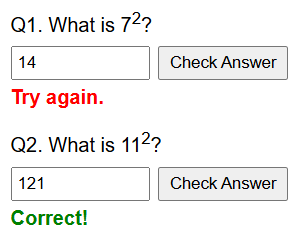
The interactive worksheet below generates questions, gives instant feedback, and lets students record their score.
What you’ll practise
- Recognising square numbers.
- Squaring a number by multiplying it by itself.
- Finding square roots of square numbers.
- Understanding that squaring and square rooting are inverse operations.
Use the interactive worksheet below, or read the Topic guide for the method and worked example.
Answer each of the questions below.
Topic guide
What this worksheet practises
This worksheet provides practice on calculating square numbers (e.g. 5²) and finding square roots (e.g. √25). These two operations are exact opposites of each other.
Key method
You must remember the difference between the two symbols.
- Squaring (the little ²): This means "multiply the number by itself". So, 7² means 7 × 7.
- Square Rooting (the √ symbol): This is the reverse process. It asks: "What number multiplied by itself gives me the number inside this symbol?".
- To succeed in non-calculator exams, you should memorise the first fifteen square numbers: 1, 4, 9, 16, 25, 36, 49, 64, 81, 100, 121, 144, 169, 196, 225.
Worked example
1) Calculate 8².
2) Calculate √81.
Example 1: (8²)
Step 1: The little 2 means multiply the big number by itself.
8 × 8 = 64.
The answer is 64.
Example 2: (√81)
Step 1: The symbol asks "What number times itself makes 81?".
Step 2: Go through your times tables. 9 × 9 = 81.
The answer is 9.
Common mistakes to avoid
The most common mistake when squaring is accidentally multiplying the number by 2 instead of itself. Many students will see 8² and quickly write "16" (because 8 × 2 = 16). This is wrong. You must do 8 × 8 = 64.
Things to remember
If you have to square a negative number, the answer will always be positive. For example, (−5)² means −5 × −5. Because two negatives multiply to make a positive, the answer is +25. This is why you cannot find the square root of a negative number (like √−25) using normal maths.