
Surface area of a cuboid
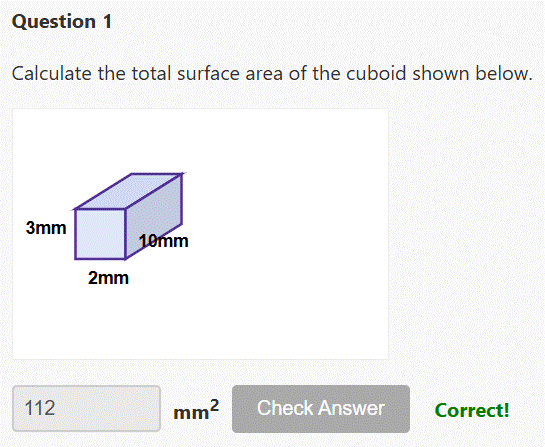
Calculating surface area is a vital skill for real-world projects, such as determining exactly how much paint is needed to cover a room or how much cardboard is required to manufacture a packaging box. It helps us measure the total area of every outside face on a 3D object. Jump to the questions
Practise now
Worksheet preview and key skills
Worksheet preview
Practise surface area of a cuboid with this self-marking maths worksheet.
The interactive worksheet below generates questions, gives instant feedback, and lets students record their score.
What you’ll practise
- Finding the areas of rectangular faces.
- Recognising the three pairs of equal faces.
- Adding all six face areas.
- Giving the total surface area in square units.
Use the interactive worksheet below, or read the Topic guide for the method and worked example.
Topic guide
What this worksheet practises
This worksheet focuses on calculating the total surface area of a cuboid (a rectangular box). Unlike a cube, the faces of a cuboid are not all the same size. However, they do come in matching pairs.
Key method
A cuboid has 6 rectangular faces, consisting of 3 matching pairs: Top/Bottom, Front/Back, and Left/Right.
- Identify the three different dimensions of the cuboid: Length, Width, and Height.
- Calculate the area of the Front face (Length × Height) and double it (to include the Back).
- Calculate the area of the Top face (Length × Width) and double it (to include the Bottom).
- Calculate the area of the Side face (Width × Height) and double it (to include the other Side).
- Add these three pairs together to get the total surface area.
Worked example
Calculate the surface area of a cuboid with length 10cm, width 4cm, and height 5cm.
Step 1: Calculate Front/Back pair.
Front = 10 × 5 = 50.
Pair = 50 × 2 = 100.
Step 2: Calculate Top/Bottom pair.
Top = 10 × 4 = 40.
Pair = 40 × 2 = 80.
Step 3: Calculate Side/Side pair.
Side = 4 × 5 = 20.
Pair = 20 × 2 = 40.
Step 4: Add them all together.
100 + 80 + 40 = 220.
The total surface area is 220 cm².
Common mistakes to avoid
The most common mistake is forgetting to double the faces. A student might correctly calculate Front(50) + Top(40) + Side(20) = 110, but then stop. This only gives half the surface area (3 faces). A cuboid has 6 faces, so you must always remember the hidden pairs.
Things to remember
A quick mental check to ensure you haven't missed any combinations: If the dimensions are numbers A, B, and C, your three area calculations should be (A×B), (B×C), and (A×C). Every number must multiply every other number once.