
The discriminant
Ever wondered how you can tell if a quadratic equation will have two solutions, one, or none—without solving it? That’s where the discriminant comes in. Jump to the questions
Practise now
Worksheet preview and key skills
Worksheet preview
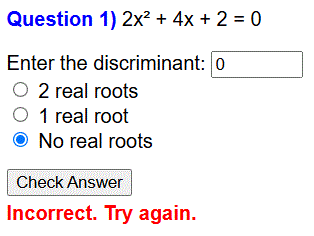
Practise using the discriminant with this self-marking maths worksheet.
The interactive worksheet below generates questions, gives instant feedback, and lets students record their score.
What you’ll practise
- Identifying a, b and c.
- Calculating b² − 4ac.
- Interpreting whether there are two, one or no real roots.
- Using the sign of the discriminant.
Use the interactive worksheet below, or read the Topic guide for the method and worked example.
Topic guide
What this worksheet practises
This worksheet focuses on calculating and interpreting the "discriminant" of a quadratic equation (ax² + bx + c = 0). The discriminant is a quick test that tells you exactly how many roots (solutions) the equation has, without having to actually solve the whole thing.
Key method
The formula for the discriminant is a small part of the main Quadratic Formula: b² − 4ac.
- Identify the values for a, b, and c from your quadratic equation. (Ensure the equation equals zero first).
- Substitute these values carefully into the formula b² − 4ac.
- Calculate the final number.
- Interpret the result:
- If the answer is Positive (greater than zero), the equation has two distinct real roots (it crosses the x-axis twice).
- If the answer is exactly Zero, the equation has one repeated real root (it just touches the x-axis once).
- If the answer is Negative (less than zero), the equation has no real roots (it floats above or below the x-axis and never crosses it).
Worked example
Use the discriminant to determine the number of real roots for the equation 3x² − 5x + 4 = 0.
Step 1: Identify a, b, and c.
a = 3, b = −5, c = 4.
Step 2: Substitute into b² − 4ac. Always use brackets for negative numbers!
(−5)² − (4 × 3 × 4)
Step 3: Calculate.
25 − (48)
25 − 48 = −23.
Step 4: Interpret the result.
Because the discriminant is negative (−23), there are no real roots.
Common mistakes to avoid
The single most common error is miscalculating the 'b²' part when 'b' is a negative number. If you type -5² into a calculator without brackets, it gives -25. A squared number must always be positive. You must type (-5)² to get +25. This mistake will completely change your final interpretation.
Things to remember
The discriminant is just the bit that lives "inside the square root" of the full quadratic formula. The rules make logical sense: you cannot square root a negative number (no roots), the square root of zero is just zero (one root), and the square root of a positive number gives a ± result (two roots).