
Converting fractions into percentages
Converting fractions into percentages is a useful skill in everyday life—from working out discounts in a shop to understanding how much of a pizza you actually ate! It helps us compare parts of a whole in a way that's quick and easy to understand. Jump to the questions
Practise now
Worksheet preview and key skills
Worksheet preview
Practise converting fractions into percentages with this self-marking maths worksheet.
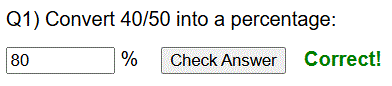
The interactive worksheet below generates questions, gives instant feedback, and lets students record their score.
What you’ll practise
- Recognising that percentages are out of 100.
- Converting the fraction to an equivalent fraction over 100 where possible.
- Or dividing numerator by denominator and multiplying by 100.
- Writing the answer with a percent sign.
Use the interactive worksheet below, or read the Topic guide for the method and worked example.
Convert each fraction into a percentage.
Topic guide
What this worksheet practises
This worksheet provides practice on converting fractions into percentages. Fractions and percentages are two different ways of showing a proportion of a whole. Being able to convert between them is essential for comparing test scores, discounts, and probability.
Key method
Percent literally means "out of 100". Therefore, the simplest way to turn a fraction into a percentage is to change its denominator (the bottom number) to 100.
- Look at the denominator of your fraction. Find what you need to multiply it by to make exactly 100.
- Multiply the numerator (the top number) by the exact same value to create an equivalent fraction.
- Once your fraction is out of 100, the top number is your percentage.
- If the denominator doesn't easily multiply into 100, convert the fraction to a decimal first by dividing the top by the bottom, then multiply by 100.
Worked example
Convert 7/20 into a percentage.
Step 1: Look at the denominator (20). We need to multiply 20 by 5 to make 100.
Step 2: Multiply the numerator by the same number (5).
7 × 5 = 35.
Step 3: Write the new equivalent fraction.
35/100.
Step 4: The top number is the percentage.
The answer is 35%.
Common mistakes to avoid
A common error is multiplying the fraction itself by 100 incorrectly, or only multiplying the bottom number. You must create an equivalent fraction by multiplying both top and bottom by the same amount. If you only multiply the bottom, you are actually making the fraction much smaller.
Things to remember
Memorise the common conversions to save time in exams. You should instantly know that 1/2 is 50%, 1/4 is 25%, 3/4 is 75%, and 1/10 is 10%. Knowing these allows you to quickly estimate if your other calculations are correct.