
Trip Tycoon - maths budgeting activity
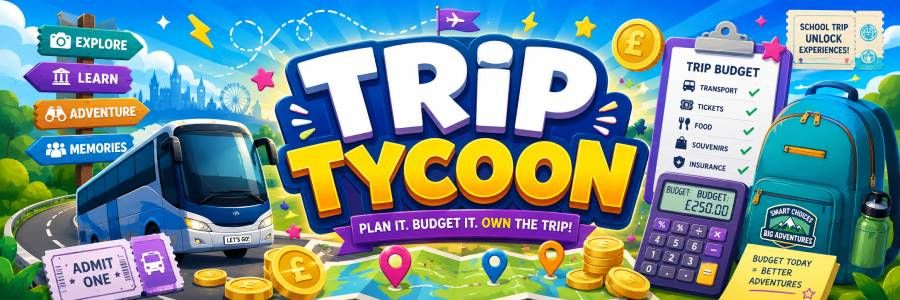
Can you plan three school trips, keep the budget under control and survive the inevitable chaos?
Trip Tycoon is a financial literacy game built around school-trip planning. Students answer maths questions to raise money, make spending decisions, respond to unexpected events and try to finish each trip with enough cash, enough buzz and enough common sense to avoid financial disaster.
The game is designed for classroom use, especially end-of-term lessons where you want something more purposeful than just “watch this educational video”.
How the game works
Students work through three trip days. Each day has a different trip scenario and a fresh set of decisions.
They will need to:
- answer maths questions to raise funds;
- choose trip options and manage costs;
- respond to surprise incidents;
- balance money, enjoyment and risk;
- check their final result at the end of each round.
The game includes a final report screen that students can screenshot to show their result.
Maths skills included
The game gives students a chance to practise maths in a more applied setting, including:
- calculations with money;
- addition, subtraction, multiplication and division;
- fractions and percentages of amounts;
- ratio and proportion-style reasoning;
- interpreting information from tables and charts;
- simple algebraic thinking;
- problem-solving in context.
Rather than presenting these skills as isolated worksheet questions, the game places them inside decisions: Can you afford this option? Which choice gives better value? What happens if the cost changes?
Classroom use
This activity works well as a pair or small-group task. Students can discuss their choices, compare outcomes and try again to unlock different endings.
Suggested use:
- give students 35–60 minutes;
- let them work in pairs if devices are limited;
- ask students to screenshot the final result screen;
- optionally award prizes for best result, most dramatic failure or most financially sensible team.
Different students may see slightly different routes through the game, so it is not just a race to copy someone else’s answers.
Teacher note
The game is intended as a light, replayable financial-literacy activity rather than a formal assessment. It is best used to prompt discussion about budgeting, trade-offs, value for money and the consequences of small decisions adding up.