
Two-step equations
Solving two-step equations is a key part of cracking problems in science, engineering, and everyday situations—like calculating how much phone data you've used after a monthly fee and a charge per GB. It’s all about reversing the steps to find the missing number. Jump to the questions
Practise now
Worksheet preview and key skills
Worksheet preview
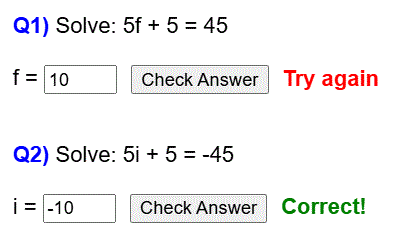
Practise solving two-step equations with this self-marking maths worksheet.
The interactive worksheet below generates questions, gives instant feedback, and lets students record their score.
What you’ll practise
- Undoing addition or subtraction and multiplication or division in the correct order.
- Keeping both sides balanced.
- Checking the solution.
Use the interactive worksheet below, or read the Topic guide for the method and worked example.
Topic guide
What this worksheet practises
This worksheet builds on simple equations by introducing two-step equations. You will need to perform two inverse operations to isolate the unknown variable and find its value.
Key method
When solving two-step equations, you generally reverse the standard order of operations (BIDMAS). This means you should usually deal with any addition or subtraction first, before moving on to multiplication or division.
- Identify any loose numbers added or subtracted from the term containing your letter, and use the inverse operation on both sides to remove them.
- Once the term with the letter is isolated, use inverse multiplication or division to find the value of the single letter.
Worked example
Solve the equation: 3x − 4 = 11
Step 1: Deal with the subtraction first. The inverse is addition, so add 4 to both sides.
3x = 11 + 4
3x = 15
Step 2: Now deal with the multiplication. 3x means 3 times x. The inverse is division, so divide both sides by 3.
x = 15 ÷ 3
x = 5
Common mistakes to avoid
A frequent error is trying to divide before dealing with the addition or subtraction. For example, dividing the equation 3x − 4 = 11 by 3 first would give x − 1.33 = 3.66, which makes the problem much harder to solve. Always isolate the x term first.