
Probability as fractions, decimals or percentages
Probability helps us measure how likely something is to happen—whether it's winning a game, catching the bus on time, or flipping heads on a coin. We can express these chances as fractions, decimals, or percentages, depending on the situation. Understanding all three forms helps you interpret real-world risks and make better decisions. Jump to the questions
Practise now
Worksheet preview and key skills
Worksheet preview
Practise probability as fractions, decimals or percentages with this self-marking maths worksheet.
The interactive worksheet below generates questions, gives instant feedback, and lets students record their score.
What you’ll practise
- Writing probability as a fraction, decimal or percentage.
- Recognising that probabilities are between 0 and 1.
- Converting between probability formats.
- Interpreting probability values correctly.
Use the interactive worksheet below, or read the Topic guide for the method and worked example.
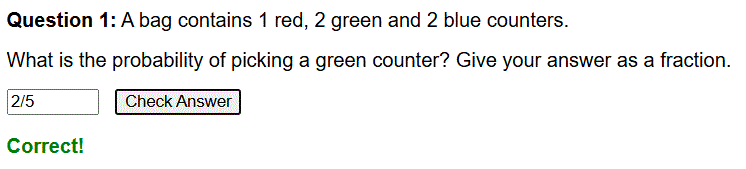
Calculate the probability of picking the specified counter. Format your answers as requested.
Topic guide
What this worksheet practises
This worksheet provides practice on calculating simple probabilities and writing the answers correctly. A probability describes how likely an event is to happen. It can be written as a fraction, a decimal, or a percentage, but all probabilities must lie between 0 (impossible) and 1 (certain).
Key method
Fractions are usually the easiest way to write a probability.
- Count the total number of possible outcomes. This number goes on the bottom of your fraction (the denominator).
- Count the number of "successful" outcomes (the things you actually want to happen). This number goes on the top of your fraction (the numerator).
- If the question asks for a decimal or percentage, convert your fraction at the end.
Worked example
A bag contains 3 red balls, 5 blue balls, and 2 green balls. A ball is chosen at random. What is the probability of picking a blue ball?
Step 1: Find the total number of balls.
3 + 5 + 2 = 10 balls total. Our denominator is 10.
Step 2: Find the number of successful outcomes.
There are 5 blue balls. Our numerator is 5.
Step 3: Write the probability.
As a fraction: 5/10 (which simplifies to 1/2).
As a decimal: 0.5
As a percentage: 50%
Common mistakes to avoid
The single most common mistake is writing a probability as a ratio. For example, writing the probability of picking a blue ball as "5:5" (5 blue to 5 non-blue). Never write a probability as a ratio with a colon. It will be marked wrong in any exam. Always use a fraction.
Things to remember
The probability of an event happening, plus the probability of it not happening, must always add up to exactly 1 (or 100%). If the probability of rain is 0.2, the probability of it not raining is 0.8.