
Vectors (Foundation)
This worksheet provides practice with Foundation-level vectors. You will practise reading and writing column vectors, drawing a given vector on a grid, describing translations, and completing simple vector arithmetic.
A vector describes a displacement, meaning a movement with a specific distance and direction. You will also learn how to describe a short route on a shape using basic vector addition and subtraction. Jump to the questions
Practise now
Worksheet preview and key skills
Worksheet preview
This interactive worksheet covers basic column vectors and straightforward combinations, suitable for GCSE Foundation tier.
You will use interactive grids to draw vectors and read translation vectors directly from diagrams.
What you’ll practise
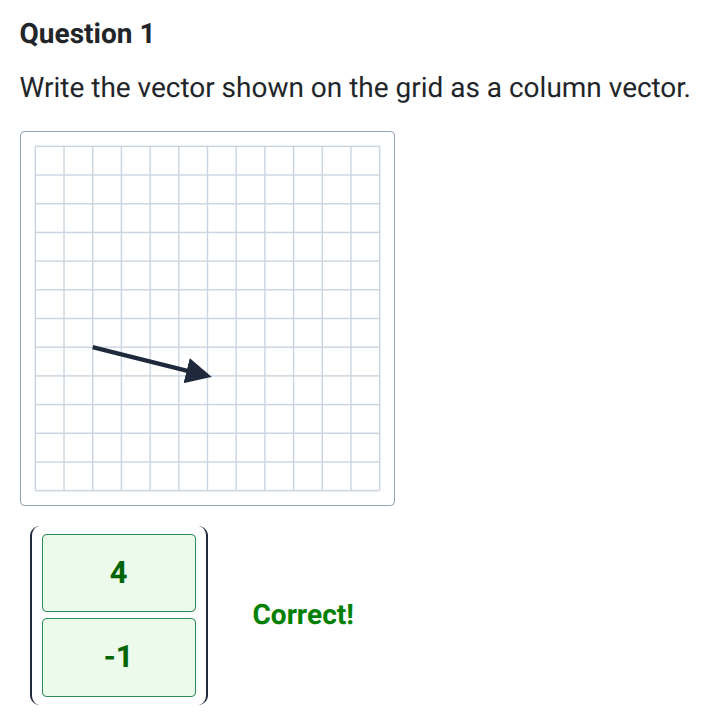
- Writing a column vector from a diagram
- Describing the translation of a shape
- Drawing a vector from a starting point
- Multiplying a column vector by a scalar
- Adding and subtracting column vectors
- Finding the vector between two coordinate points
- Describing a simple route on a parallelogram
Use the interactive worksheet below, or read the Topic guide for the method and worked example.
Vectors (Foundation)
Answer the questions below.
Topic guide
A vector describes a movement or displacement. It tells you how far to move and in which direction.
Column vectors
We usually write vectors as a column vector inside large brackets. It has two numbers:
- The top number tells you the horizontal movement (right is positive, left is negative).
- The bottom number tells you the vertical movement (up is positive, down is negative).
For example, the vector \(\binom{3}{-2}\) means move 3 units right, and 2 units down.
Vector arithmetic
When you multiply a vector by a number (a scalar), you multiply both the top and the bottom numbers by that value. If \(\mathbf{a} = \binom{2}{4}\), then \(3\mathbf{a} = \binom{6}{12}\).
When you add or subtract vectors, you add or subtract the top numbers together, and the bottom numbers together. If \(\mathbf{a} = \binom{2}{5}\) and \(\mathbf{b} = \binom{-1}{3}\), then \(\mathbf{a} + \mathbf{b} = \binom{2 + -1}{5 + 3} = \binom{1}{8}\).
Vectors between points
To find the vector from point \(A\) to point \(B\), subtract the coordinates of the starting point \(A\) from the destination point \(B\).
If \(A\) is \((1, 2)\) and \(B\) is \((4, 6)\), the vector \(\overrightarrow{AB}\) is \(\binom{4 - 1}{6 - 2} = \binom{3}{4}\).
Simple vector routes
When you are given a shape like a parallelogram with some labelled vector edges, you can describe a route along the edges using those vectors. If you travel against the direction of an arrow, you must make the vector negative.
For example, if you need to get from \(D\) to \(B\), you might first travel from \(D\) to \(A\), and then from \(A\) to \(B\). If \(\overrightarrow{AD} = \mathbf{b}\), then travelling from \(D\) to \(A\) is \(-\mathbf{b}\). If \(\overrightarrow{AB} = \mathbf{a}\), the whole route \(\overrightarrow{DB}\) is \(-\mathbf{b} + \mathbf{a}\), which can also be written as \(\mathbf{a} - \mathbf{b}\).