
Area of a Triangle Using Sine
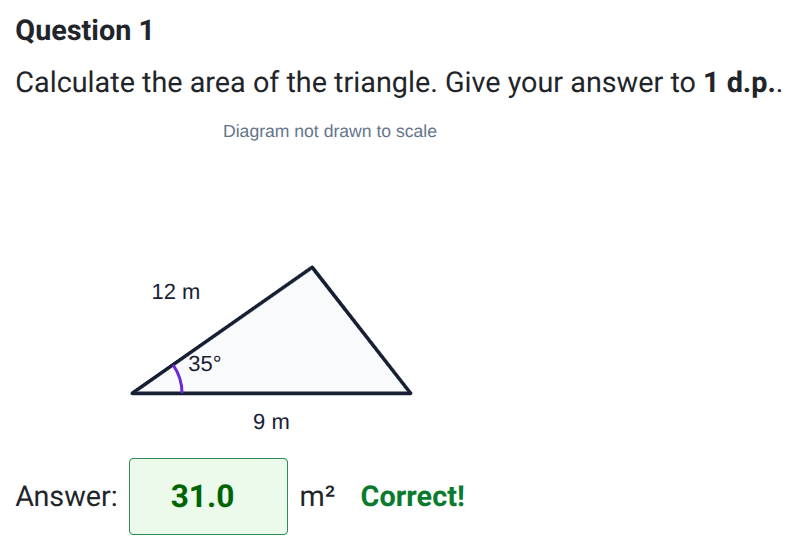
Practise calculating the area of a triangle from two sides and their included angle using A = ½ab sin C. The questions also develop rearranging the formula to find a missing side, choosing the correct acute or obtuse angle, and solving an algebraic area problem.
Use a calculator in degree mode and pay close attention to the requested rounding. Jump to the questions
Practise now
Worksheet preview and key skills
Worksheet preview
Eight self-marking questions use clear triangle diagrams to practise the formula A = ½ab sin C.
The sequence moves from finding areas to missing sides, acute and obtuse included angles, and a final algebraic problem.
What you’ll practise
- Finding triangle areas to a stated accuracy.
- Rearranging the formula to find a side.
- Using the correct inverse-sine branch for an acute or obtuse angle.
Use the interactive worksheet below, or read the Topic guide for the method and worked example.
Use A = ½ab sin C, where C is the included angle. Use degree mode and give each answer to the stated accuracy.
Topic guide
The formula
When two side lengths and the angle between them are known, the area of a triangle is A = ½ab sin C. The angle C must be the included angle: the angle where sides a and b meet. Set your calculator to degree mode.
Finding an area
For sides 7 cm and 10 cm with an included angle of 50°, A = ½ × 7 × 10 × sin 50° = 26.8 cm² to 1 decimal place.
Finding a missing side
Rearrange A = ½ab sin C to make a side the subject. For example, a = 2A ÷ (b sin C). Keep the full calculator value until the final rounding step.
Finding the included angle
First calculate sin C = 2A ÷ (ab), then use inverse sine. A positive sine value can correspond to an acute angle θ or the supplementary obtuse angle 180° − θ. Use the statement that the angle is acute or obtuse to choose the correct branch.
Algebra example
If the enclosing sides are (x + 3) cm and (x + 5) cm, the angle is 30°, and the area is 12 cm², then ½(x + 3)(x + 5)sin 30° = 12. Since sin 30° = ½, (x + 3)(x + 5) = 48.
This simplifies to x² + 8x − 33 = 0, so (x − 3)(x + 11) = 0. The roots are 3 and −11, but −11 would give negative side lengths, so x = 3.
Common mistakes
- Using an angle that is not between the two known sides.
- Leaving the calculator in radians instead of degrees.
- Rounding during an intermediate calculation.
- Forgetting the supplementary obtuse angle when using inverse sine.