
3D Trigonometry
Use 3D trigonometry to find lengths and angles in cuboids, triangular prisms and pyramids. This Grade 7 calculator worksheet develops the key skill of turning a spatial problem into one or two right-angled triangles.
You will practise finding horizontal projections, identifying angles between lines and planes, and combining Pythagoras with SOHCAHTOA without rounding too early. Jump to the questions
Practise now
Worksheet preview and key skills
Worksheet preview
This eight-question calculator worksheet progresses from trigonometry on a cuboid face to space diagonals, prisms and pyramid face–plane angles.
Every question uses a right-angled trigonometric ratio. Harder questions require a projection or an intermediate length found using Pythagoras.
What you’ll practise
- Using SOHCAHTOA on vertical faces and 3D cross-sections
- Finding the angle a line makes with a plane from its projection
- Finding pyramid edge–plane and face–plane angles
Use the interactive worksheet below, or read the Topic guide for the method and worked example.
Use Pythagoras and right-angled trigonometry. Give angles to 1 decimal place and lengths to 3 significant figures; keep full calculator values until the final answer.
Topic guide
Turn the 3D shape into a right triangle
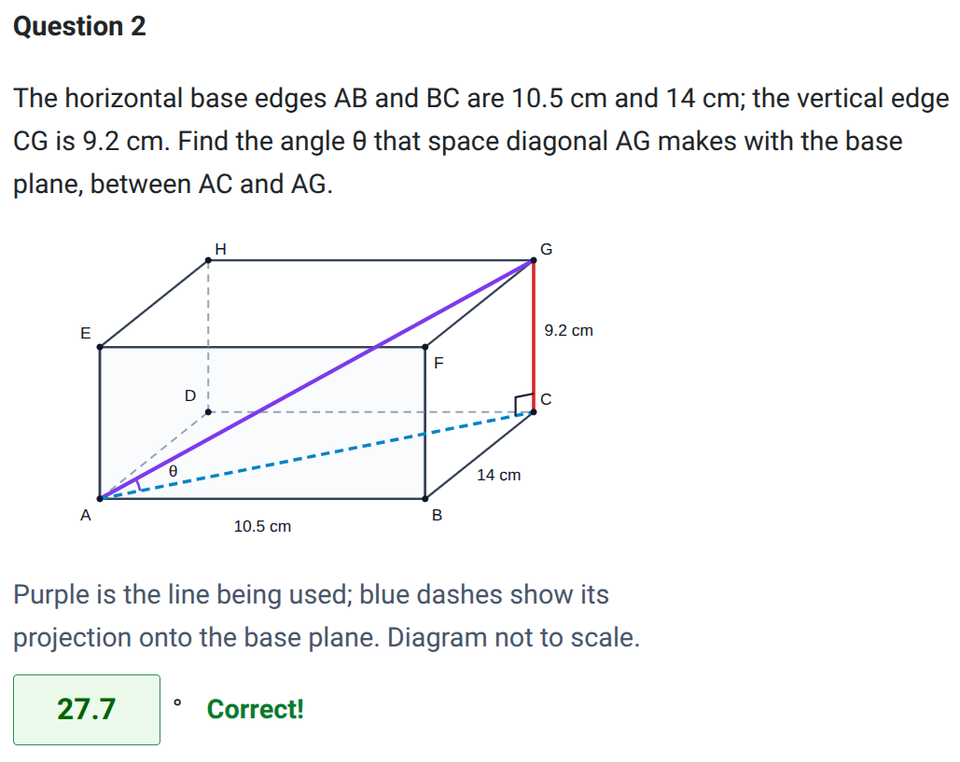
SOHCAHTOA still works in three dimensions, but only after you identify a genuine right-angled triangle. A useful first step is often to draw or calculate the projection of a sloping line onto a horizontal plane. The sloping line, its projection and the vertical height then form a right triangle.
The angle between a line and a plane is the acute angle between the line and its projection onto that plane. It is not normally the angle between the line and a convenient base edge.
Worked cuboid example
A cuboid has base edges 8 cm and 15 cm and height 10 cm. Find the angle θ that its space diagonal makes with the base plane.
- Find the projection of the space diagonal across the base: √(8² + 15²) = 17 cm.
- Use the right triangle formed by the 10 cm height, the 17 cm projection and the space diagonal: tan θ = 10/17.
- θ = tan−1(10/17) = 30.5° to 1 decimal place.
Angles between a face and a base
For a pyramid face–plane angle, take a cross-section perpendicular to the shared base edge. If E is the apex, M is the midpoint of that edge and O is the centre of the base, then EM lies in the triangular face and OM lies in the base. When both are perpendicular to the shared edge, angle EMO is the angle between the face and the base.
Useful checks
- Mark the projection before choosing sine, cosine or tangent.
- Use Pythagoras only for an intermediate right-triangle length; every final problem here also needs trigonometry.
- Keep the full calculator value through chained calculations and round only the final answer.
- Check that an angle to a horizontal plane is measured up from the horizontal projection.