
Congruent Triangles
Practise deciding when two triangles must be congruent using SSS, SAS, ASA and RHS. You will also reject insufficient information and complete short geometric proofs involving parallelograms, angle facts and tangents to a circle. Jump to the questions
Practise now
Worksheet preview and key skills
Worksheet preview
Eight self-marking questions progress from recognising congruence criteria to completing short proofs.
Each new set selects from carefully checked diagrams, including rotated triangles, a parallelogram and tangents to a circle.
What you’ll practise
- Recognising SSS, SAS, ASA and RHS.
- Explaining why AAA or SSA does not guarantee congruence.
- Completing concise proofs with shared sides, angle sums and tangent facts.
Use the interactive worksheet below, or read the Topic guide for the method and worked example.
Enter the requested criterion or proof step. Each question is worth one mark and must be fully correct.
Topic guide
Congruent triangles have exactly the same size and shape. Their matching sides have equal lengths and their matching angles are equal, even when one triangle has been rotated or reflected.
The four criteria
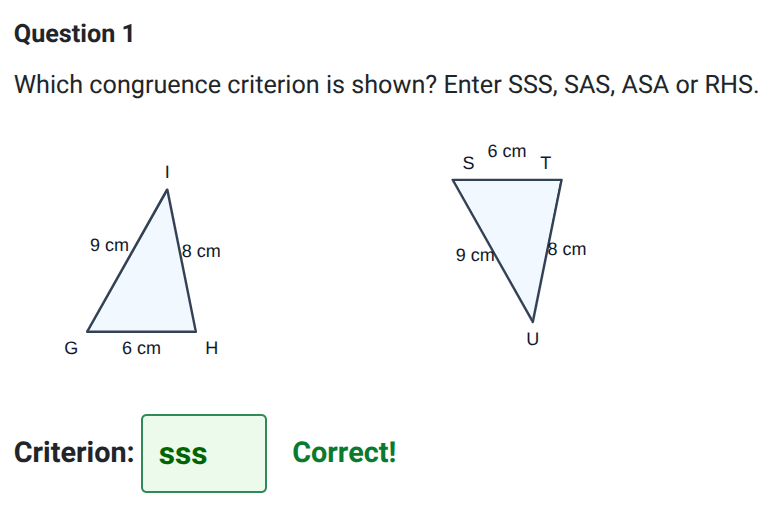
- SSS: all three pairs of corresponding sides are equal.
- SAS: two pairs of corresponding sides and the angle included between them are equal.
- ASA: two pairs of corresponding angles and the included side are equal. A missing angle may first be found using the angle sum of a triangle.
- RHS: both triangles are right-angled, their hypotenuses are equal and one other pair of corresponding sides is equal.
AAA fixes shape but not size, so it proves similarity rather than congruence. SSA is also insufficient in general: two sides and a non-included angle can sometimes make different triangles.
Worked parallelogram proof
In parallelogram ABCD, diagonal AC forms triangles ABC and CDA. Opposite sides give AB = CD and BC = DA. The diagonal is common, so AC = CA. Therefore triangle ABC is congruent to triangle CDA by SSS. Notice that the vertex order records the correspondence A↔C, B↔D and C↔A.
RHS with tangents
Suppose tangents from an external point B touch a circle at A and C, and O is the centre. A radius is perpendicular to a tangent at the point of contact, so angles OAB and OCB are right angles. Also OA = OC because they are radii, and OB is the shared hypotenuse. Thus triangles OAB and OCB are congruent by RHS.
Useful checks
- Match vertices before writing triangle names.
- For SAS, check that the stated angle lies between the two stated sides.
- For RHS, identify the side opposite each right angle: that is the hypotenuse.
- Do not assume equal lengths or angles merely because a diagram looks symmetrical.