
Converting percentages to decimals
When you see “25 % off” on a pair of trainers or your gaming accuracy listed as 78 %, turning that percentage into a decimal—0.25 or 0.78—gives you the exact numbers you need to work out prices, stats, and scores without the percent sign getting in the way. Jump to the questions
Practise now
Worksheet preview and key skills
Worksheet preview
Practise converting percentages to decimals with this self-marking maths worksheet.
The interactive worksheet below generates questions, gives instant feedback, and lets students record their score.
What you’ll practise
- Dividing the percentage by 100.
- Moving digits two places carefully.
- Writing the result as a decimal.
- Recognising common percentage-decimal equivalents.
Use the interactive worksheet below, or read the Topic guide for the method and worked example.
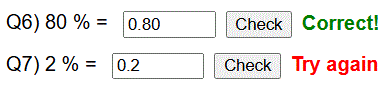
Convert each percentage to a decimal. Type your answer and click “Check Answer”.
Topic guide
What this worksheet practises
This worksheet focuses on converting percentages into decimals. This is a very common requirement in compound interest and depreciation questions, where you need a decimal "multiplier" to make the calculation efficient.
Key method
Percent literally translates to "out of 100". Therefore, any percentage is simply that number divided by 100.
- Take the percentage value and remove the % sign.
- Divide the number by 100.
- To divide by 100 mentally, move the decimal point two places to the left.
Worked example
Convert 42% into a decimal.
Step 1: Remove the % sign to leave 42.
Step 2: Divide by 100 by moving the decimal point (which is currently after the 2) two places to the left.
42 → 4.2 → 0.42
The answer is 0.42.
Common mistakes to avoid
The most frequent mistake involves single-digit percentages. Converting 5% to 0.5 is a classic error. 0.5 is actually 50%. You must move the decimal point two places, which requires adding a zero: 5% ÷ 100 = 0.05.
Things to remember
If the percentage is greater than 100%, the decimal will start with a whole number. For instance, a 125% increase means you have 125% of the original, which converts to the decimal multiplier 1.25.