
Coordinates in the first quadrant
Coordinates in the first quadrant help us describe positions on a grid using pairs of numbers, like a treasure map! They’re used in video game design, navigation, and even plotting the flight path of a drone. Learning to plot and read these coordinates can make math feel more like solving a real-world puzzle! Jump to the questions
Looking for coordinates in all 4 quadrants?
Practise now
Worksheet preview and key skills
Worksheet preview
Practise coordinates in the first quadrant with this self-marking maths worksheet.
The interactive worksheet below generates questions, gives instant feedback, and lets students record their score.
What you’ll practise
- Reading ordered pairs.
- Using the x-coordinate first and y-coordinate second.
- Plotting points in the first quadrant.
- Using positive coordinates.
Use the interactive worksheet below, or read the Topic guide for the method and worked example.
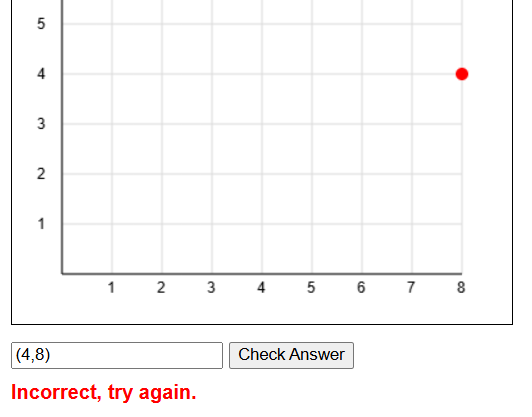
Type the coordinates of the red dot e.g. (3, 2).
You MUST remember the brackets!
Topic guide
What this worksheet practises
This worksheet focuses on reading and plotting coordinates in the first quadrant. The first quadrant only uses positive numbers for both the x-axis (horizontal) and y-axis (vertical). This is the foundation of all graphing and map-reading skills.
Key method
Coordinates are written as a pair of numbers in brackets, separated by a comma: (x, y). The order is extremely important.
- Start at the origin, which is the point (0, 0) in the bottom-left corner where the two axes meet.
- Look at the first number (the x-coordinate). Move that many spaces to the right along the horizontal axis.
- Look at the second number (the y-coordinate). Move that many spaces straight up parallel to the vertical axis.
- Mark the position with a small cross.
Worked example
Write down the coordinates of a point located 5 units right and 2 units up from the origin.
Step 1: The horizontal movement is the x-coordinate. It is 5 units right, so x = 5.
Step 2: The vertical movement is the y-coordinate. It is 2 units up, so y = 2.
Step 3: Combine them in the standard format (x, y).
The coordinates are (5, 2).
Common mistakes to avoid
The classic error is reversing the coordinates, reading the y-axis first and the x-axis second. Remember the rule: "Along the corridor, then up the stairs." You must move horizontally before you move vertically. Plotting (2, 5) instead of (5, 2) will put your point in an entirely wrong location.
How to check your answer
When you have plotted a point, read its coordinates backwards from the cross to the axes. Trace a straight line down to the bottom axis to check your first number, and trace a straight line to the side axis to check your second number.