
Coordinates in all 4 quadrants
Coordinates in all four quadrants help us map points on a grid, just like using a GPS to find a location. Whether it's tracking the path of a video game character or plotting a route on a city map, understanding coordinates allows us to navigate space accurately in every direction! Jump to the questions
Looking for coordinates in the first quadrant only?
Practise now
Worksheet preview and key skills
Worksheet preview
Practise coordinates in all 4 quadrants with this self-marking maths worksheet.
The interactive worksheet below generates questions, gives instant feedback, and lets students record their score.
What you’ll practise
- Reading ordered pairs.
- Using positive and negative coordinates.
- Plotting points across all four quadrants.
- Checking the signs of x and y carefully.
Use the interactive worksheet below, or read the Topic guide for the method and worked example.
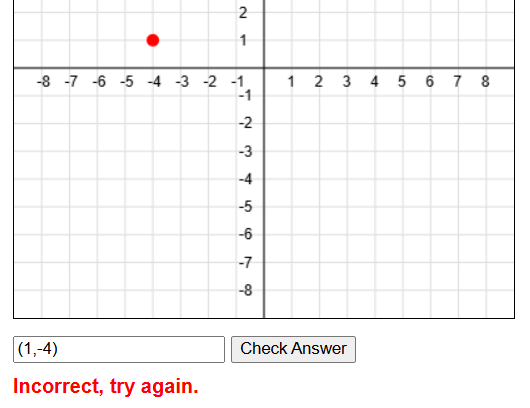
Type the coordinates of the red dot e.g. (3, -2).
You MUST remember the brackets!
Topic guide
What this worksheet practises
This worksheet provides practice on reading and plotting coordinates in all four quadrants. This is an essential foundation for geometry, reading maps, and drawing graphs. It introduces the concept of negative coordinates on both the x-axis (horizontal) and y-axis (vertical).
Key method
Coordinates are always written in brackets, with the x-coordinate first and the y-coordinate second: (x, y).
- Always start at the origin (0, 0), where the two axes cross.
- Read the first number (the x-coordinate). Move left if it is negative, or right if it is positive.
- Read the second number (the y-coordinate). From your current position, move down if it is negative, or up if it is positive.
- Plot the point with a small, clear cross.
Worked example
Plot the coordinate (−3, 4) on a grid.
Step 1: Start at the origin (0, 0).
Step 2: The x-coordinate is −3. Move 3 spaces to the left.
Step 3: The y-coordinate is 4. Move 4 spaces straight up.
Step 4: Draw a small cross at that exact intersection.
Common mistakes to avoid
The most common mistake is swapping the x and y coordinates around, plotting (4, −3) instead of (−3, 4). Remember the classic phrase: "Along the corridor, then up (or down) the stairs." The horizontal movement always comes first. Another error is counting the grid squares instead of reading the numbers printed on the axes, especially when the scale goes up in 2s or 5s.
Things to remember
The four quadrants have standard coordinate signs. Top-right is (+, +). Top-left is (−, +). Bottom-left is (−, −). Bottom-right is (+, −). Checking these signs quickly tells you if you are in the correct quadrant.