
Finding missing sides with trigonometry
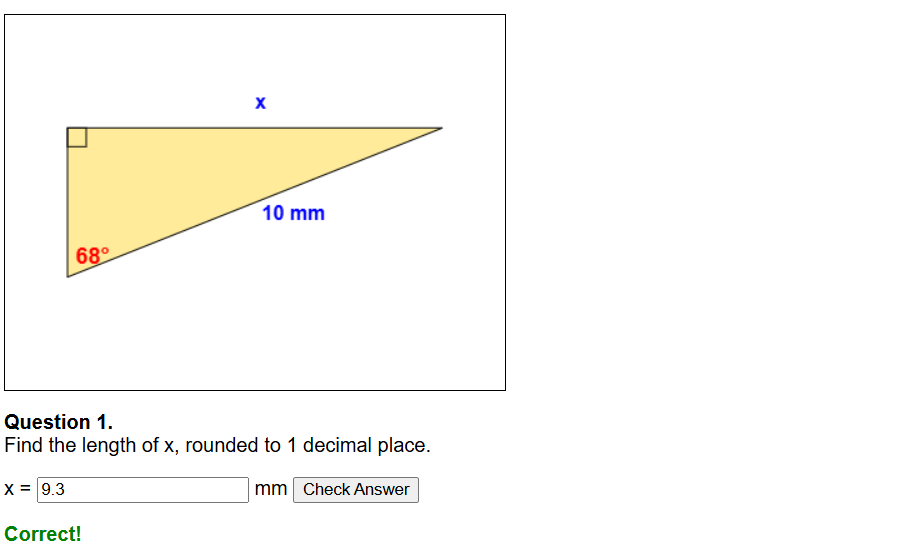
Trigonometry helps us solve real-world problems, like finding the height of a building or the distance across a river, without measuring them directly. By using the angles and a known side of a right triangle, we can calculate the missing sides with tools like sine, cosine, and tangent. Jump to the questions
Practise now
Worksheet preview and key skills
Worksheet preview
Practise finding missing sides with trigonometry with this self-marking maths worksheet.
The interactive worksheet below generates questions, gives instant feedback, and lets students record their score.
What you’ll practise
- Identifying the opposite, adjacent and hypotenuse sides.
- Choosing sine, cosine or tangent.
- Substituting known values into the correct ratio.
- Solving for the missing side.
Use the interactive worksheet below, or read the Topic guide for the method and worked example.
Answers should be correctly rounded to 1 decimal place.
Topic guide
What this worksheet practises
This worksheet provides practice on finding the lengths of missing sides in right-angled triangles using trigonometry (SOH CAH TOA). This is used when you know one angle and one side, and need to find a second side.
Key method
Use the SOH CAH TOA acronym to identify the correct equation, and then use algebra to solve it.
- Label the sides: Hypotenuse (longest), Opposite (across from the known angle), and Adjacent (next to the known angle).
- Identify the side you know, and the side you want to find.
- Choose the ratio (Sin, Cos, or Tan) that contains those two specific sides.
- Set up the equation (e.g. cos(angle) = A/H).
- Use algebra to isolate the unknown side. (If the unknown is on top, multiply. If the unknown is on the bottom, swap it with the trig function).
Worked example
A right-angled triangle has an angle of 40°. The hypotenuse is 12cm. Find the length of the adjacent side.
Step 1: We know the Hypotenuse (H) and want the Adjacent (A).
Step 2: SOH CAH TOA tells us that A and H means we must use Cos.
Step 3: Set up the equation.
cos(40°) = A / 12
Step 4: Solve for A. The unknown is on top, so we multiply.
A = 12 × cos(40°)
Step 5: Calculate the result.
A = 9.19 cm (to 2 d.p.)
Common mistakes to avoid
The most frequent error occurs when the unknown side is on the bottom of the fraction (e.g. sin(30) = 5/H). Students often try to multiply (5 × sin30), which is wrong. If the unknown is on the bottom, you must divide the number by the trig function: H = 5 ÷ sin(30).
How to check your answer
Always remember that the hypotenuse is the longest side of a right-angled triangle. If you calculate an Opposite or Adjacent side and it comes out larger than the Hypotenuse, you have definitely made a mistake (usually multiplying when you should have divided).