
Finding angles using trigonometry
Trigonometry helps us find missing angles in triangles, a skill that's used in real life to design bridges, measure the height of buildings, or even track the path of a rocket. By applying sine, cosine, and tangent, we can unlock the secrets hidden within the angles of any right-angled triangle! Jump to the questions
Practise now
Worksheet preview and key skills
Worksheet preview
Practise finding angles using trigonometry with this self-marking maths worksheet.
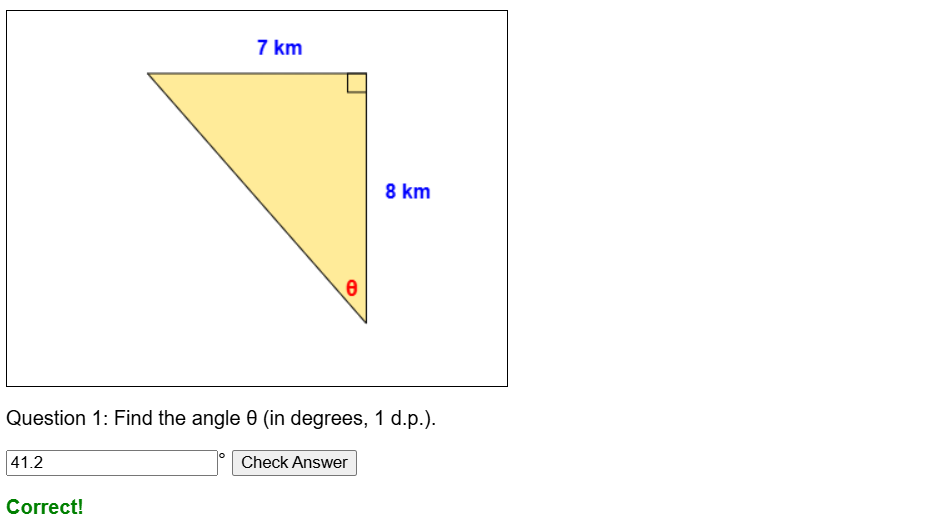
The interactive worksheet below generates questions, gives instant feedback, and lets students record their score.
What you’ll practise
- Identifying the relevant sides.
- Choosing sine, cosine or tangent.
- Using inverse trigonometric functions.
- Calculating the missing angle.
Use the interactive worksheet below, or read the Topic guide for the method and worked example.
Answers should be rounded to 1 decimal place (in degrees).
Topic guide
What this worksheet practises
This worksheet provides practice on finding missing angles in right-angled triangles using trigonometry (SOH CAH TOA). This relies on using the inverse trigonometric functions (sin&supmin;¹, cos&supmin;¹, tan&supmin;¹) on your calculator.
Key method
Use the SOH CAH TOA acronym to identify the correct trigonometric ratio.
- Label the three sides of the triangle: Hypotenuse (longest side), Opposite (across from the angle you want to find), and Adjacent (next to the angle).
- Identify which two sides you know the lengths of.
- Choose the correct ratio (Sin, Cos, or Tan) that uses those two sides.
- Set up your equation (e.g. sin(x) = O/H).
- Use the inverse function on your calculator (e.g. shift + sin) to find the angle.
Worked example
Find the missing angle 'x' in a right-angled triangle where the Opposite side is 5cm and the Hypotenuse is 10cm.
Step 1: We know the Opposite (O) and the Hypotenuse (H).
Step 2: Looking at SOH CAH TOA, O and H means we must use Sin.
Step 3: Set up the equation.
sin(x) = 5 / 10
sin(x) = 0.5
Step 4: Use the inverse sin function to find the angle.
x = sin&supmin;¹(0.5)
x = 30°
Common mistakes to avoid
A fatal error is forgetting to use the inverse button (shift). Pressing 'sin(0.5)' on your calculator gives 0.0087, which is obviously incorrect for an angle in a triangle. Another common mistake is having your calculator set to Radians (RAD) instead of Degrees (DEG). Always check for a small 'D' or 'DEG' at the top of your calculator screen.
How to check your answer
Look at the triangle visually. A 30° angle should look quite sharp (a third of a right angle). If you calculate an angle of 85°, but the diagram clearly shows a very sharp, thin point, you have likely chosen the wrong ratio or divided the sides backwards.