
Dividing Algebraic Fractions
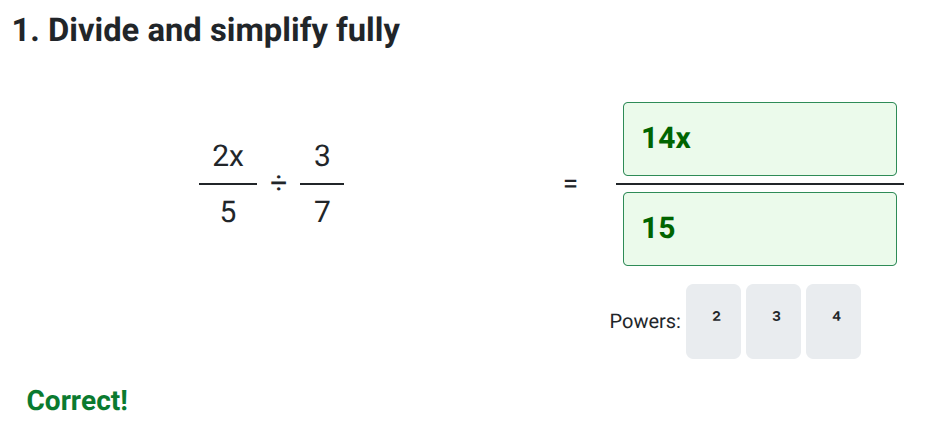
Practise dividing algebraic fractions by multiplying by the reciprocal of the second fraction. This GCSE Higher worksheet builds from simple fractions and index laws to cancelling bracket factors and factorising quadratics, including non-monic quadratics at approximately Grade 7.
Give each answer as one fully simplified fraction. The eight self-marking questions award one mark each, with hints to help you correct mistakes. Jump to the questions
Practise now
Worksheet preview and key skills
Worksheet preview
Eight questions on dividing algebraic fractions, progressing from the reciprocal step to Grade 7 factorisation. Each question is worth one mark.
Enter your simplified numerator and denominator separately. Use denominator 1 for a whole expression, and the power buttons for expressions such as x2.
What you’ll practise
- Multiplying by the reciprocal of the second fraction.
- Reducing coefficients and cancelling powers of x using index laws.
- Keeping brackets intact and cancelling only complete factors.
- Factorising linear expressions, monic quadratics, differences of two squares and non-monic quadratics.
Use the interactive worksheet below, or read the Topic guide for the method and worked examples. New questions selects from four variants at each stage.
Dividing Algebraic Fractions
Divide each pair and simplify fully. Enter the numerator and denominator separately; use denominator 1 for a non-fraction answer. Use the ², ³ or ⁴ buttons for powers; add brackets where needed.
Topic guide
Divide by multiplying by the reciprocal
The reciprocal of a fraction swaps its numerator and denominator. To divide algebraic fractions, keep the first fraction and multiply by the reciprocal of the second fraction. Invert the whole second fraction, including any brackets.
The original denominators and the divisor must be non-zero. Any values excluded by these conditions remain excluded after cancellation.
- Keep the first fraction unchanged.
- Replace division with multiplication by the reciprocal of the second fraction.
- Factorise expressions where necessary.
- Cancel common numerical and algebraic factors, then multiply the remaining numerators and denominators.
- Check that the result is fully simplified.
The reciprocal and basic cancellation
x4 ÷ 35 = x4 × 53 = 5x12
6x7 ÷ 9x14 = 6x7 × 149x = 43
After taking the reciprocal, you may cancel factors before multiplying or simplify the resulting single fraction afterwards.
Powers and brackets
Use index laws when cancelling powers: x4 divided by x2 leaves x2. Subtract exponents when dividing powers with the same base.
3x48 ÷ 9x24 = 3x48 × 49x2 = x26
4x5 ÷ x+63 = 4x5 × 3x+6 = 12x5(x+6)
The bracket x+6 remains a complete factor in the denominator. Its x term cannot cancel with the x in the numerator.
Visible bracket cancellation
x+4x−1 ÷ x+4x+2 = x+4x−1 × x+2x+4 = x+2x−1
Now x+4 is a complete factor above and below the fraction bar, so it cancels. Only complete factors can cancel, never individual terms separated by + or −.
Factorise linear expressions first
3x+125 ÷ 2x+87x = 3(x+4)5 × 7x2(x+4) = 21x10
Extracting the numerical common factors reveals the matching bracket x+4.
Monic quadratics and differences of two squares
For x2+bx+c, find two integers whose sum is b and whose product is c. For example, x2+x−6 = (x+3)(x−2).
x2+x−6x+5 ÷ x−2x+1 = (x+3)(x−2)x+5 × x+1x−2 = (x+3)(x+1)x+5
A difference of two squares factorises as a2−b2 = (a−b)(a+b). Watch the order of a subtraction: 4−x is −(x−4).
16−x2x+2 ÷ x−4x+7 = (4−x)(4+x)x+2 × x+7x−4 = −(x+4)(x+7)x+2
Harder factorisation at Grade 7
For a non-monic quadratic, the coefficient of x2 is not equal to 1. To factorise 2x2+11x+5, split 11x into 10x+x and group: 2x(x+5)+(x+5) = (2x+1)(x+5). Factorise every expression that could help cancellation.
2x2+11x+5x2−9 ÷ 2x+1x−3 = (2x+1)(x+5)(x−3)(x+3) × x−32x+1 = x+5x+3
A fully reduced answer can be expanded or factorised. For example, (x+2)(x+3) and x2+5x+6 are equivalent numerator forms. Neither form should leave a common factor with the denominator.
Common mistakes to avoid
- Forgetting the reciprocal, or inverting the first fraction or both fractions. Invert only the second fraction.
- Inverting only part of a fraction. Move the whole numerator and whole denominator.
- Cancelling individual terms or only part of a bracket. Factorise first and cancel complete factors.
- Adding exponents when cancelling powers, or losing a minus sign when reversing a subtraction.
- Stopping at an equivalent fraction that still has a common numerical or polynomial factor.
Enter numerator and denominator expressions separately; use denominator 1 for a non-fraction result. Multiplying algebraic fractions as the original operation is covered in a separate worksheet.