
Multiplying Algebraic Fractions
Practise multiplying algebraic fractions with this self-marking GCSE Higher worksheet, aimed at approximately Grade 7. Build from simple products and index laws to cancelling bracket factors and factorising quadratics, giving each answer in its simplest form. Jump to the questions
Practise now
Worksheet preview and key skills
Worksheet preview
Eight questions move from multiplying simple fractions in x to products that need linear and quadratic factorisation. Each question is worth one mark.
Enter a numerator and denominator, using 1 underneath for a non-fraction answer. Equivalent expanded or factorised answers are accepted when fully simplified. New Questions gives another set at the same eight stages.
What you’ll practise
- Multiplying numerators and denominators, then reducing coefficients and powers.
- Keeping brackets as factors and cancelling complete matching factors.
- Factorising linear expressions, monic and non-monic quadratics, and differences of two squares.
Use the interactive worksheet below, or read the Topic guide for the method and worked examples.
Multiplying Algebraic Fractions
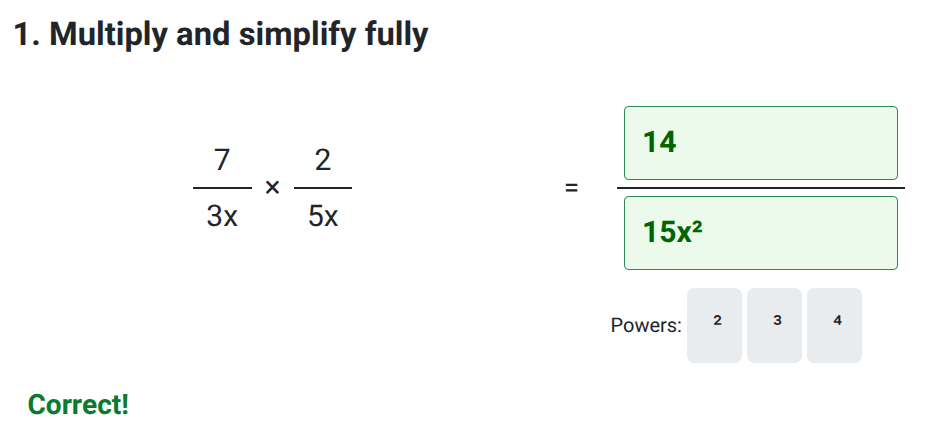
Multiply each pair and simplify fully. Enter the numerator and denominator separately; use denominator 1 for a non-fraction answer. Use the ², ³ or ⁴ buttons for powers; add brackets where needed.
Topic guide
To multiply algebraic fractions, multiply the numerators and multiply the denominators. Then simplify by cancelling common factors. You will need ordinary fraction arithmetic, index laws and factorisation.
1. Multiply top by top and bottom by bottom
No common denominator is needed for multiplication.
4x × 53 = 203x
2. Reduce numerical and variable factors
After multiplying, divide the numerator and denominator by their common factors. Here, cancel 6 and x.
3x4 × 29x = 6x36x = 16
3. Use index laws
Add powers when multiplying the same letter; subtract powers when cancelling. In this example x² × x³ = x⁵, then x⁵ divided by x² leaves x³. Reduce the numerical coefficient too.
2x29 × 3x34x2 = 6x536x2 = x36
4. Keep a bracket as a factor
Multiply the numerical parts and reduce them. You may leave a fully simplified numerator factorised or expand it correctly: x(x + 8) and x² + 8x are equivalent.
5x4 × (x+8)15 = 5x(x+8)60 = x(x+8)12
5. Cancel complete matching brackets
The whole bracket x − 2 is a factor above and below, so it cancels. Individual terms inside different brackets cannot cancel.
(x−2)(x+4) × (x+9)(x−2) = (x−2)(x+9)(x+4)(x−2) = x+9x+4
6. Factorise linear expressions first
Write 6x + 6 = 6(x + 1) and 4x + 4 = 4(x + 1). Now the matching bracket is a complete factor and can cancel; reduce 30/32 as well.
6x+68x × 54x+4 = 30(x+1)32x(x+1) = 1516x
7. Factorise quadratics and differences of two squares
For x² + 5x − 14, find two numbers with product −14 and sum 5: 7 and −2. This gives (x + 7)(x − 2).
x2+5x−14x+3 × 2x+7 = 2(x+7)(x−2)(x+3)(x+7) = 2(x−2)x+3
Use a² − b² = (a − b)(a + b). Signs matter: 9 − x² = (3 − x)(3 + x), and 3 − x = −(x − 3).
9−x2x+8 × 4x−3 = −4(x+3)x+8
8. Factorise more than one expression
For harder products, factorise each expression that needs it before cancelling. Here, 2x² + 9x + 4 = (2x + 1)(x + 4) and x² + 4x − 5 = (x + 5)(x − 1). Check these factorisations by expanding.
2x2+9x+4x2+4x−5 × x−12x+1 = x+4x+5
The complete factors x − 1 and 2x + 1 cancel. No common factor remains in (x + 4)/(x + 5).
Common mistakes
- Adding numerators or denominators: this is multiplication, so multiply them.
- Cancelling terms separated by + or −: only complete factors can cancel. For example, x cannot cancel from (x + 4)/(x + 5).
- Leaving a common numerical factor or power of x: check both coefficients and indices.
- Cancelling only part of a bracket, or losing a minus sign when reversing a subtraction.
- Expanding too early: keeping factorised brackets often makes cancellation easier.
- Stopping at an equivalent fraction that still has a common factor: the final answer must be fully simplified.
Enter a non-fraction answer with denominator 1. You do not need to state excluded values in this exercise.
Division uses the reciprocal of the second fraction before multiplying. It is covered separately and is not practised here.