
Enlargements with negative scale factors
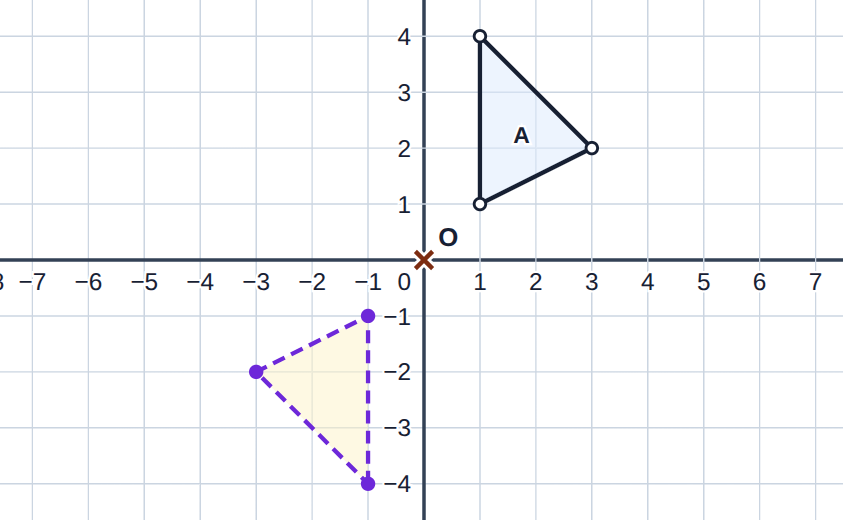
Practise enlargements with negative scale factors for GCSE Higher. Construct complete images on coordinate grids, work from centres at and away from the origin, and describe enlargements using both the scale factor and centre.
The centre stays your fixed reference point. A negative scale factor puts the image on the opposite side of it; the size of the factor tells you how far away each image vertex lies. The eight questions build from −1 to negative integers and fractions, before two diagram-based descriptions. Jump to the questions
Practise now
Worksheet preview and key skills
Worksheet preview
Eight questions, worth one mark each, on negative scale factor enlargements at GCSE Higher, around Grade 6.
Questions 1–3 construct images using −1, then −2 or −3, starting at the origin and moving to a non-origin centre. Questions 4–5 use −1/2 (−0.5) and −3/2 (−1.5). Question 6 constructs a quadrilateral about a non-origin centre using a negative integer or fractional factor. Questions 7–8 show two shapes and ask for the full enlargement description, first with an integer factor and then a fractional factor.
What you’ll practise
- Placing every image vertex on the opposite side of the centre.
- Using negative integer and fractional factors to make larger and smaller images.
- Working relative to a centre away from the origin.
- Finding both the scale factor and centre from corresponding vertices.
Use the interactive worksheet below, or read the Topic guide for the method and worked examples.
Enlargements with negative scale factors
Place every image vertex, then check your answer. For Questions 7–8, enter the scale factor and centre of enlargement.
Topic guide
What does a negative scale factor mean?
Negative enlargements are GCSE Higher content. You need to be confident reading coordinates and counting horizontal and vertical distances on a grid. The centre of enlargement is the fixed reference point for every vertex.
The negative sign puts each image point on the opposite side of the centre, along the same straight line as the original point. The magnitude (the size of the factor without its sign) multiplies the distance from the centre.
- Scale factor −1: the image is the same size, on the opposite side of the centre.
- Factors below −1, such as −2 or −1.5: the image is larger.
- Factors between −1 and 0, such as −1/2 or −0.5: the image is smaller.
Constructing the image
- Think of a line from the centre through an original vertex.
- Extend the line through the centre to the opposite side.
- Multiply the distance from the centre by the size of the scale factor and mark the image vertex.
- Repeat for every vertex, then join corresponding image vertices around the boundary.
For diagonal lines, count the horizontal and vertical movements from the centre. Multiply both by the factor: a negative factor reverses both directions. Always work from the centre, even when it is not the origin.
Worked integer example
Enlarge the triangle with vertices (2, 1), (4, 1) and (2, 2) by scale factor −2 about C = (1, −1).
From C to (2, 1), move 1 right and 2 up. The image point needs 2 left and 4 down from C, so it is (−1, −5). For (4, 1), the movements 3 right and 2 up become 6 left and 4 down, giving (−5, −5). From C to (2, 2), move 1 right and 3 up; the image needs 2 left and 6 down from C to reach (−1, −7). Join these three image vertices.
Worked fractional example
Enlarge the triangle (4, 2), (6, 2), (4, 6) by scale factor −1/2 about the origin. Halve each distance and move to the opposite side: the image vertices are (−2, −1), (−3, −1), (−2, −3).
The image is smaller because the magnitude is 1/2. The negative sign tells you the direction, not whether the shape gets bigger or smaller.
Describing an enlargement fully
Give both the scale factor and the centre. Join corresponding vertices and extend their lines to find the centre. Compare distances from that centre to a matching pair, using a negative factor when they lie on opposite sides. Check another pair before you decide.
For example, suppose A has vertices (3, 1), (4, 1), (3, 3), and B has corresponding vertices (0, −2), (−2, −2), (0, −6). Their joining lines meet at (2, 0). From this centre, the movements to (3, 1) are 1 right and 1 up; to (0, −2), they are 2 left and 2 down. The other pairs confirm the same factor. The full description is enlargement, scale factor −2, centre (2, 0).
Common mistakes
- Treating −2 as +2: the negative sign puts the image across the centre, not on the original side.
- Moving to the wrong side: check that the centre lies between each original vertex and its image.
- Multiplying coordinates directly when the centre is not the origin: first count from the given centre.
- Using the wrong distance: −1/2 halves the distance; −3/2 multiplies it by one and a half.
- Forgetting the centre in a full description: a scale factor alone is incomplete.
- Giving a positive factor just because the image is larger or smaller: its side of the centre decides the sign.
- Judging by appearance alone: check corresponding vertices and exact grid coordinates.