
Expanding double brackets with surds
Expanding double brackets containing surds is a skill you'll often need when simplifying expressions in algebra, especially in topics like geometry or trigonometry where square roots naturally appear. Whether you're working out areas involving irrational lengths or manipulating formulas in physics, understanding how to expand these brackets helps you tidy up complex expressions and spot hidden patterns. Jump to the questions
Practise now
Worksheet preview and key skills
Worksheet preview
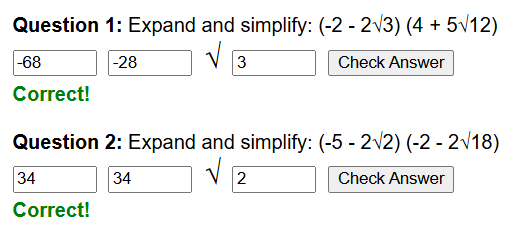
Practise expanding double brackets with surds with this self-marking maths worksheet.
The interactive worksheet below generates questions, gives instant feedback, and lets students record their score.
What you’ll practise
- Multiplying each term in the first bracket by each term in the second bracket.
- Applying surd multiplication rules.
- Simplifying surd products.
- Collecting like terms or like surds.
Use the interactive worksheet below, or read the Topic guide for the method and worked example.
Topic guide
What this worksheet practises
This worksheet provides practice on expanding double brackets where the terms involve surds (square roots that cannot be simplified to whole numbers). This combines standard algebraic expansion techniques (like FOIL) with the rules for multiplying and simplifying surds.
Key method
Use the FOIL method (First, Outside, Inside, Last) exactly as you would with standard algebra, but apply the rules of surds when multiplying.
- First: Multiply the first terms in each bracket.
- Outside: Multiply the two outer terms.
- Inside: Multiply the two inner terms.
- Last: Multiply the last terms in each bracket. Remember that √a × √a simply equals 'a'.
- Finally, collect any like terms. Regular numbers add to regular numbers, and matching surds (e.g. 3√2 + 4√2) add together to make 7√2.
Worked example
Expand and simplify (3 + √2)(5 − √2).
Step 1: First terms.
3 × 5 = 15.
Step 2: Outside terms.
3 × (−√2) = −3√2.
Step 3: Inside terms.
√2 × 5 = +5√2.
Step 4: Last terms.
√2 × (−√2) = −2. (Because √2 × √2 is 2, and a positive times a negative is negative).
Step 5: Write it out and collect like terms.
15 − 3√2 + 5√2 − 2.
(15 − 2) + (−3√2 + 5√2) = 13 + 2√2.
The final answer is 13 + 2√2.
Common mistakes to avoid
A frequent error is treating a number multiplied by a surd incorrectly. For example, calculating 3 × √2 as √6. A whole number cannot multiply inside a square root. 3 × √2 is simply written as 3√2.
Things to remember
If you have matching brackets with opposite signs, such as (3 + √2)(3 − √2), this is called the "difference of two squares". The middle surd terms will perfectly cancel each other out, leaving you with just an ordinary whole integer as your final answer.