
Rationalising the denominator - easier questions
Rationalising the denominator is a useful skill that often pops up when working with fractions in algebra and trigonometry. It's especially helpful in simplifying expressions, making them easier to work with in real-life applications like physics and engineering, where messy square roots can complicate calculations. Jump to the questions
Practise now
Worksheet preview and key skills
Worksheet preview
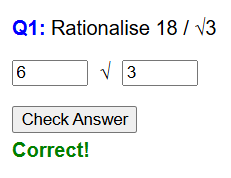
Practise rationalising the denominator with this self-marking maths worksheet.
The interactive worksheet below generates questions, gives instant feedback, and lets students record their score.
What you’ll practise
- Identifying a simple surd in the denominator.
- Multiplying numerator and denominator by the same surd.
- Simplifying the denominator.
- Writing the answer without a surd in the denominator.
Use the interactive worksheet below, or read the Topic guide for the method and worked example.
Topic guide
What this worksheet practises
This worksheet provides practice on "rationalising the denominator". In mathematics, it is considered bad practice to leave a surd (a square root) on the bottom of a fraction. Rationalising is the process of removing the root from the bottom, without changing the actual value of the fraction.
Key method
The core technique relies on the rule that multiplying a square root by itself makes it a normal whole number (e.g. √3 × √3 = 3).
- Look at the fraction. Identify the surd on the bottom (e.g. √5).
- Multiply both the top and the bottom of the fraction by that exact same surd. You must do it to both top and bottom to keep the fraction equivalent.
- Multiply out the numerator (the top).
- Multiply out the denominator (the bottom). The roots will cancel each other out, leaving a normal integer.
- Simplify: Look at your final fraction. Can the outside numbers be simplified like a normal fraction?
Worked example
Rationalise the denominator of 6 / √2.
Step 1: The surd on the bottom is √2. We must multiply top and bottom by √2.
( 6 × √2 ) / ( √2 × √2 )
Step 2: Multiply the top.
6 × √2 = 6√2.
Step 3: Multiply the bottom.
√2 × √2 = √4 = 2.
Step 4: Combine the new fraction.
We now have 6√2 / 2.
Step 5: Simplify. The outside numbers are 6 and 2. Because 6 divides by 2 exactly, we can simplify this.
6 ÷ 2 = 3.
The final, fully simplified answer is 3√2.
Common mistakes to avoid
The most common mistake is forgetting to simplify the final fraction. If you leave the answer as 6√2 / 2, you will lose the final mark. Always check if the top whole number and the bottom whole number can be divided.
Things to remember
You are not changing the size of the number, only its appearance. 6 / √2 and 3√2 are mathematically identical. You are essentially multiplying the fraction by 1 (because √2 / √2 is equal to 1), which is why the overall value doesn't change.