
Rationalising the denominator - medium difficulty
Rationalising the denominator is a useful skill that often pops up when working with fractions in algebra and trigonometry. It's especially helpful in simplifying expressions, making them easier to work with in real-life applications like physics and engineering, where messy square roots can complicate calculations. Jump to the questions
Practise now
Worksheet preview and key skills
Worksheet preview
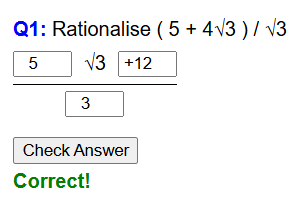
Practise rationalising the denominator with this self-marking maths worksheet.
The interactive worksheet below generates questions, gives instant feedback, and lets students record their score.
What you’ll practise
- Identifying a surd in the denominator.
- Multiplying numerator and denominator by a suitable surd or conjugate.
- Simplifying the denominator.
- Writing the answer without a surd in the denominator.
Use the interactive worksheet below, or read the Topic guide for the method and worked example.
Topic guide
What this worksheet practises
This worksheet provides practice on rationalising denominators where the bottom of the fraction contains a number and a root multiplied together (e.g. 5√3). The goal is to remove the root from the bottom without changing the value of the fraction.
Key method
You only need to multiply by the root part, not the whole bottom expression.
- Identify the surd part of the denominator (e.g. in 4√7, the surd is just √7).
- Multiply both the top and the bottom of the fraction by this surd. Do not multiply by the whole 4√7.
- Multiply the numerator (the top). If the top has multiple terms, remember to multiply all of them by the surd.
- Multiply the denominator (the bottom). The roots will combine to form a whole integer, which is then multiplied by the integer already there.
- Simplify the final fraction if the outside numbers share a common factor.
Worked example
Rationalise the denominator of 10 / 3√5.
Step 1: The surd part is √5. We multiply top and bottom by √5.
( 10 × √5 ) / ( 3√5 × √5 )
Step 2: Multiply the top.
10 × √5 = 10√5.
Step 3: Multiply the bottom. (√5 × √5 = 5).
3 × 5 = 15.
Step 4: Combine the new fraction.
We now have 10√5 / 15.
Step 5: Simplify. The outside numbers (10 and 15) both divide by 5.
The fully simplified answer is 2√5 / 3.
Common mistakes to avoid
A common mistake is multiplying top and bottom by the entire denominator (e.g. multiplying by 3√5). While this will eventually give you the correct answer, it creates unnecessarily large numbers (30√5 / 45) that are much harder to simplify at the end. Only multiply by the root.
Things to remember
If the numerator is a complex expression like (2 + √3) and you are rationalising by multiplying by √5, you must treat the top like a bracket: √5 × (2 + √3) = 2√5 + √15. Every part of the top gets multiplied.