
Rationalising the denominator - harder problems
Rationalising the denominator is a useful skill that often pops up when working with fractions in algebra and trigonometry. It's especially helpful in simplifying expressions, making them easier to work with in real-life applications like physics and engineering, where messy square roots can complicate calculations. Jump to the questions
Practise now
Worksheet preview and key skills
Worksheet preview
Practise rationalising the denominator with harder problems with this self-marking maths worksheet.
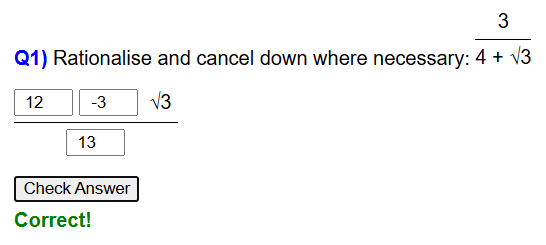
The interactive worksheet below generates questions, gives instant feedback, and lets students record their score.
What you’ll practise
- Identifying a binomial denominator involving a surd.
- Multiplying by the conjugate.
- Using the difference of two squares where relevant.
- Simplifying the final expression without a surd in the denominator.
Use the interactive worksheet below, or read the Topic guide for the method and worked example.
Topic guide
What this worksheet practises
This worksheet focuses on the hardest type of rationalising questions, where the denominator (bottom) of the fraction contains two terms (e.g. 3 + √2). You cannot simply multiply top and bottom by √2, as this will not remove the root from the bottom.
Key method
You must multiply the top and the bottom by the "conjugate" of the denominator. The conjugate is the exact same expression, but with the opposite sign in the middle.
- Identify the denominator (e.g. 5 − √3). Its conjugate is 5 + √3.
- Multiply the top of the fraction by this conjugate. This often requires expanding double brackets.
- Multiply the bottom of the fraction by this conjugate. If done correctly, this will always create a "difference of two squares" expansion. The middle terms will cancel out, and the roots will vanish, leaving an integer.
- Write out the new fraction and simplify it if possible.
Worked example
Rationalise the denominator of 4 / (3 + √2).
Step 1: Find the conjugate of the bottom. It is (3 − √2).
Step 2: Multiply the top by the conjugate.
4 × (3 − √2) = 12 − 4√2.
Step 3: Multiply the bottom by the conjugate (expanding double brackets).
(3 + √2)(3 − √2) = 9 − 3√2 + 3√2 − 2.
The middle roots cancel out (+3√2 and −3√2), leaving 9 − 2 = 7.
Step 4: Combine the new fraction.
The final answer is (12 − 4√2) / 7.
Common mistakes to avoid
The most common error is miscalculating the final term when expanding the bottom brackets. In our example, students correctly calculate √2 × −√2, but mistakenly write down −4 instead of −2. Remember that a root times itself just removes the root symbol.
Things to remember
When multiplying the bottom (a + √b)(a − √b), the shortcut is simply a² − b. This works every single time and saves you from writing out the full double bracket expansion. In our example, 3² − 2 = 9 − 2 = 7.