
Multiplying surds
Multiplying surds comes up when we deal with roots in areas like geometry and physics, especially when working with measurements that aren’t whole numbers. It’s a key skill for simplifying messy square roots into neater expressions – perfect for when you're tackling problems involving areas, distances, or even Pythagoras' Theorem! Jump to the questions
Practise now
Worksheet preview and key skills
Worksheet preview
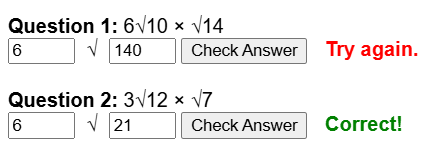
Practise multiplying surds with this self-marking maths worksheet.
The interactive worksheet below generates questions, gives instant feedback, and lets students record their score.
What you’ll practise
- Multiplying numbers under square root signs.
- Simplifying the resulting surd where possible.
- Using square factors to simplify.
- Keeping exact surd form.
Use the interactive worksheet below, or read the Topic guide for the method and worked example.
Topic guide
What this worksheet practises
This worksheet provides practice on multiplying surds (square roots that do not result in a whole number). Surds behave very similarly to algebraic terms like 'x' or 'y', but they have one special multiplication rule that makes them unique.
Key method
The fundamental rule of multiplying surds is: √a × √b = √(a × b). You can combine them under a single root.
- Multiply the numbers that are outside the square roots together.
- Multiply the numbers that are inside the square roots together, keeping the result inside a new square root.
- Combine these two parts into your answer.
- Simplify (Important): Look at the number inside your new square root. Can it be divided by a square number (4, 9, 16, 25...)? If so, you must simplify the surd.
Worked example
Calculate 3√2 × 4√5.
Step 1: Multiply the outside numbers.
3 × 4 = 12.
Step 2: Multiply the inside numbers.
√2 × √5 = √10.
Step 3: Combine them.
The final answer is 12√10.
Worked example 2 (Simplifying)
Calculate √6 × √8.
Step 1: Multiply the insides.
√6 × √8 = √48.
Step 2: Simplify √48. The largest square number that goes into 48 is 16.
√48 = √(16 × 3) = √16 × √3
Because √16 is exactly 4, the final simplified answer is 4√3.
Common mistakes to avoid
A common error is trying to add the numbers inside the surd instead of multiplying them (writing √6 × √8 = √14). Another frequent mistake occurs when a surd is multiplied by itself. Remember that √5 × √5 = √25, which is exactly 5. Multiplying a square root by itself just "pops" the number out of the root.
Things to remember
While you can multiply surds together under one roof (√2 × √3 = √6), you cannot do this for addition. √2 + √3 does not equal √5. Addition requires the surds to be completely identical, like collecting like terms in algebra.