
Simplifying surds
Simplifying surds helps us express square roots (and other roots) in their simplest form, making calculations easier and neater. Surds often pop up in areas like architecture and engineering, where precise, non-decimal answers are needed — such as calculating the exact length of a diagonal beam! Jump to the questions
Practise now
Worksheet preview and key skills
Worksheet preview
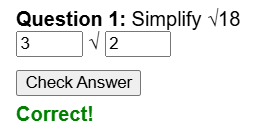
Practise simplifying surds with this self-marking maths worksheet.
The interactive worksheet below generates questions, gives instant feedback, and lets students record their score.
What you’ll practise
- Identifying square-number factors.
- Rewriting surds using square factors.
- Simplifying roots while keeping the answer exact.
- Recognising when a surd cannot be simplified further.
Use the interactive worksheet below, or read the Topic guide for the method and worked example.
Topic guide
What this worksheet practises
This worksheet focuses on simplifying surds. A surd is a square root that cannot be solved to give a whole number (like √20). Simplifying a surd means pulling as much whole-number value out of the root symbol as possible.
Key method
The secret to simplifying surds is finding hidden square numbers.
- Write out a list of square numbers to help you: 4, 9, 16, 25, 36, 49...
- Look at your surd (e.g. √50). Find the largest square number from your list that divides exactly into the number inside the root.
- Split the surd into two separate roots multiplied together: the square root × the remaining root.
- Calculate the root of the square number to turn it into a normal integer.
- Write the normal integer first, attached to the remaining root.
Worked example
Simplify √72.
Step 1: Find a square number that divides into 72. (9 works, but 36 is the largest square number that works).
72 = 36 × 2.
Step 2: Split the root.
√72 = √36 × √2.
Step 3: Solve the square root part. We know that √36 is exactly 6.
So, √36 × √2 becomes 6 × √2.
Step 4: Push them together.
The final answer is 6√2.
Common mistakes to avoid
The most common mistake is picking a factor that isn't a square number. A student might look at √72 and split it into √8 × √9. While mathematically true, if neither number is a perfect square, you cannot simplify it further. Always ensure one of your splits is from the square number list.
Things to remember
If you pick a smaller square number (e.g. splitting √72 into √9 × √8), you will get 3√8. This is correct, but not fully simplified, because 8 contains another hidden square number (4). You would then have to simplify the √8. Finding the largest square number straight away saves you this double-work.