
Unitary method
The unitary method and direct proportion are tools we use every day without even realizing it—whether you’re scaling up a recipe for more people or working out how much a group ticket costs if you know the price for one person. Both help us solve problems where two quantities increase or decrease at the same rate, making calculations faster and more logical. Jump to the questions
Practise now
Worksheet preview and key skills
Worksheet preview
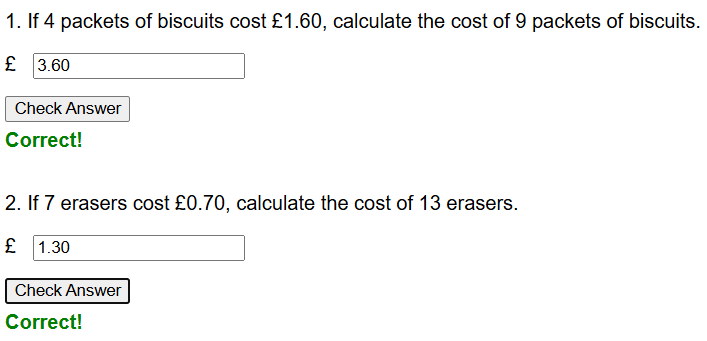
Practise the unitary method with this self-marking maths worksheet.
The interactive worksheet below generates questions, gives instant feedback, and lets students record their score.
What you’ll practise
- Finding the value of one item or one part.
- Scaling from one value to another.
- Using multiplication or division to solve proportion problems.
- Checking that the proportion matches the question.
Use the interactive worksheet below, or read the Topic guide for the method and worked example.
Topic guide
What this worksheet practises
This worksheet provides practice on the "unitary method". This is a powerful problem-solving technique used when dealing with direct proportion (e.g. buying multiple items). The method involves finding the value of a single "unit" first, before calculating the final amount.
Key method
The unitary method is a strict two-step process: Divide, then Multiply.
- Step 1 (Find One): Look at the information given (e.g. 5 apples cost £2.00). Divide the total cost by the number of items to find the cost of exactly one item. (Cost ÷ Quantity = Cost of 1).
- Step 2 (Scale Up): Look at what the question is asking for (e.g. Find the cost of 7 apples). Multiply the cost of a single item by the new quantity you need. (Cost of 1 × New Quantity = Final Answer).
Worked example
If 4 identical pens cost £1.20 in total, how much would 9 of these pens cost?
Step 1: Find the cost of exactly ONE pen.
£1.20 ÷ 4 = £0.30 (or 30p).
One pen costs 30p.
Step 2: Multiply the cost of one pen by the number of pens you want.
£0.30 × 9 = £2.70.
The final answer is £2.70.
Common mistakes to avoid
The most common mistake is trying to jump straight to the answer using addition. A student might think: "4 pens is 1.20. Another 4 pens is another 1.20. That's 8 pens for 2.40. I just need one more pen, so I'll guess it costs 50p... total is 2.90." This additive guessing is completely unreliable. Always divide down to 1 first.
Things to remember
The unitary method is the mathematical foundation for finding the "best buy" in a supermarket. If Shop A sells 4 rolls of toilet paper for £2, and Shop B sells 9 rolls for £4.05, you use the unitary method to find the cost of a single roll in each shop (50p vs 45p) to prove which is the better deal.