
Recipe problems
Understanding recipes and proportion is vital for scaling up or down quantities when cooking, baking, or even in everyday tasks like mixing paints or chemicals safely. Jump to the questions
Practise now
Worksheet preview and key skills
Worksheet preview
Practise recipe problems with this self-marking maths worksheet.
The interactive worksheet below generates questions, gives instant feedback, and lets students record their score.
What you’ll practise
- Comparing the original and required quantities.
- Finding the scale factor.
- Multiplying or dividing ingredient amounts.
- Keeping units consistent.
Use the interactive worksheet below, or read the Topic guide for the method and worked example.
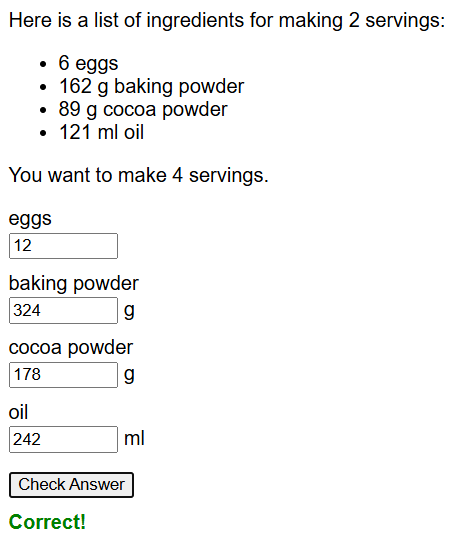
Scale the recipes up or down to find the required amount of each ingredient.
Topic guide
What this worksheet practises
This worksheet focuses on scaling recipes up or down to feed a different number of people. This is a classic application of direct proportion: if you double the people, you must exactly double every single ingredient.
Key method
The most foolproof method is the "Unitary Method" – finding out exactly how much of an ingredient is needed for just one person first.
- Look at the recipe. It will tell you how many people it serves (e.g., Serves 4).
- Find the "One Person" amount: Take an ingredient and divide its quantity by the original number of people. This tells you how much is needed to feed exactly 1 person.
- Scale Up: Multiply this "One Person" amount by the new number of people you want to feed.
- Repeat this two-step process (divide, then multiply) for every ingredient requested in the question.
Worked example
A recipe for 6 people requires 300g of flour. How much flour is needed to make the recipe for 8 people?
Step 1: Find the amount for 1 person by dividing the ingredient by the original number of people.
300g ÷ 6 = 50g.
So, 1 person needs 50g of flour.
Step 2: Scale it up. We want to feed 8 people, so we multiply our 1-person amount by 8.
50g × 8 = 400g.
The final answer is 400g.
Common mistakes to avoid
The most common mistake is trying to add or subtract instead of multiplying and dividing. For example, a student sees the people go from 6 to 8 (an addition of 2), so they just add 2 onto the ingredients (300g + 2 = 302g). This is completely wrong. Recipes use multiplicative proportion, never additive.
Things to remember
If the new number of people is a very easy multiple of the old number, you can skip the unitary method. If a recipe serves 4, and you need it for 12, you can just multiply everything directly by 3 (because 4 × 3 = 12). However, the unitary method works every single time, even for awkward numbers like scaling from 7 people to 11 people.