
Currency conversion
Understanding currency conversion is crucial when traveling, shopping online internationally, or managing a business with global customers. Jump to the questions
Practise now
Worksheet preview and key skills
Worksheet preview
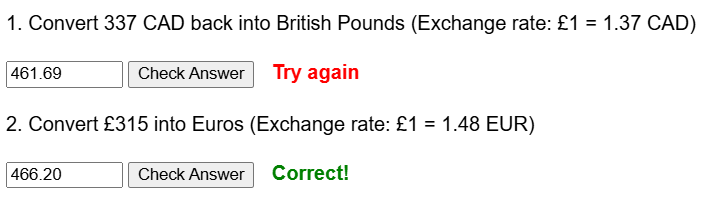
Practise currency conversion with this self-marking maths worksheet.
The interactive worksheet below generates questions, gives instant feedback, and lets students record their score.
What you’ll practise
- Using the given exchange rate.
- Multiplying or dividing depending on the direction of conversion.
- Keeping track of the correct currency.
- Rounding money sensibly where required.
Use the interactive worksheet below, or read the Topic guide for the method and worked example.
Topic guide
What this worksheet practises
This worksheet provides practice on converting money between different currencies. This is a highly practical mathematical skill used for international travel and trade. It relies heavily on ratio and direct proportion.
Key method
To convert currency, you must use the exchange rate given in the question. This acts as your multiplier.
- Identify the given exchange rate (e.g. £1 = $1.30).
- If you are changing your home currency (£) into the foreign currency, multiply the amount by the exchange rate.
- If you are changing the foreign currency back into your home currency (£), divide the amount by the exchange rate.
Worked example
The exchange rate is £1 = €1.15. Convert £400 into Euros, and then convert €345 back into Pounds.
Step 1: Convert £ to €.
We are going from the home currency to the foreign currency, so we multiply.
400 × 1.15 = 460.
The answer is €460.
Step 2: Convert € to £.
We are going backwards from the foreign currency to the home currency, so we divide.
345 ÷ 1.15 = 300.
The answer is £300.
Common mistakes to avoid
The most common mistake is dividing when you should multiply, or vice versa. If you divide 400 by 1.15, you get 347.82. But looking at the exchange rate, €1.15 is bigger than £1, so the number of Euros must be bigger than the number of Pounds. 347 is smaller than 400, proving the wrong operation was used.
How to check your answer
Always perform a quick logic check comparing the two numbers in the exchange rate. If the foreign number is larger than 1 (like 1.15), your foreign currency answer must be a larger number than your starting Pounds. If it isn't, you have multiplied/divided the wrong way around.