
Index laws of division
When dealing with powers and indices, the division rule helps simplify complex expressions. You'll often see this when working with scientific notation, coding algorithms, or even in engineering formulas where large numbers need to be broken down. Learning how to divide indices makes working with powers faster and clearer! Jump to the questions
Practise now
Worksheet preview and key skills
Worksheet preview
Practise index laws of division with this self-marking maths worksheet.
The interactive worksheet below generates questions, gives instant feedback, and lets students record their score.
What you’ll practise
- Dividing terms with the same base.
- Subtracting indices when bases match.
- Keeping the base unchanged.
- Simplifying expressions using the division index law.
Use the interactive worksheet below, or read the Topic guide for the method and worked example.
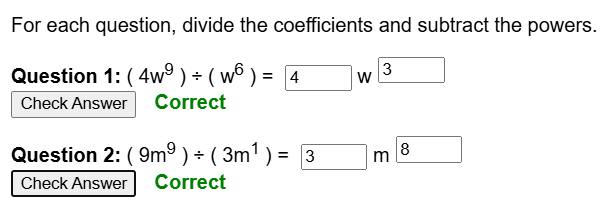
For each question, divide the coefficients and subtract the powers. Enter your answers in the input boxes.
Topic guide
What this worksheet practises
This worksheet focuses on the index law for division. When you divide two algebraic terms or numbers that share the exact same base, you can simplify the calculation by manipulating their powers (indices).
Key method
The core rule is: when dividing terms with the same base, you subtract the powers.
- Identify that the "bases" (the large numbers or letters) are identical. For example, in a&sup5; ÷ a², the base is 'a'.
- Keep the base exactly the same in your answer.
- Take the power of the first term and subtract the power of the second term.
- If there are large numbers (coefficients) at the front of the terms (e.g. 10x&sup5; ÷ 2x²), divide those normal numbers normally first (10 ÷ 2 = 5), and then subtract the powers of the letters.
Worked example
Simplify 15y&sup8; ÷ 3y².
Step 1: Divide the large normal numbers at the front.
15 ÷ 3 = 5.
Step 2: Look at the algebraic terms with the 'y' base. Apply the subtraction rule to their powers.
8 − 2 = 6.
So, y&sup8; ÷ y² becomes y&sup6;.
Step 3: Combine the two parts together.
The final answer is 5y&sup6;.
Common mistakes to avoid
The most common mistake is dividing the powers instead of subtracting them. For example, looking at x&sup8; ÷ x² and writing x&sup4; (because 8 ÷ 2 = 4). Remember, powers operate one step "down" from the main calculation. If the main calculation is division, the powers subtract.
Things to remember
If you see a letter with no power written next to it (like 'y'), it actually has a hidden power of 1 (y¹). So, y&sup5; ÷ y is calculated as 5 − 1, which equals y&sup4;.