
Exterior angles of a polygon
An exterior angle is the angle formed outside a polygon when one of its sides is extended in a straight line. In this worksheet, you'll practise finding the size of exterior angles, using the rule that exterior angles always total 360°, working backwards to find the number of sides of a regular polygon, and solving linked regular-polygon problems. Jump to the questions
Practise now
Worksheet preview and key skills
Worksheet preview
This worksheet provides self-marking practice on finding and using exterior angles of polygons.
You will start by identifying exterior angles from adjacent interior angles, then move on to finding exterior angles of regular polygons and finding the number of sides when an angle is given.
What you’ll practise
- identifying and calculating exterior angles;
- one exterior angle of a regular polygon;
- finding the number of sides;
- missing exterior angles in irregular polygons;
- ratio and linked-polygon reasoning.
Use the interactive worksheet below, or read the Topic guide for the method and worked example.
Exterior angles of a polygon
Practise finding exterior angles, using the 360° total, working backwards to find the number of sides, and solving linked regular-polygon problems.
Topic guide
1. What an exterior angle is
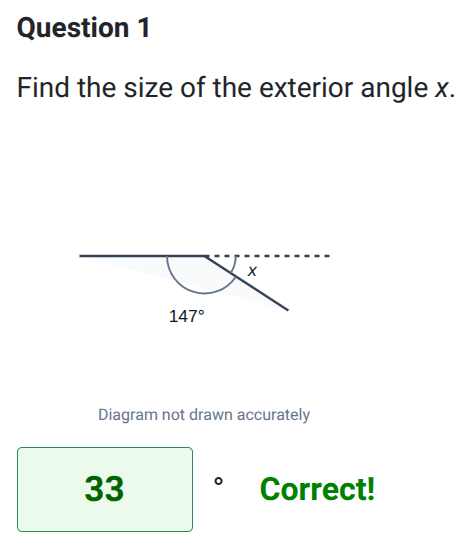
An exterior angle is the angle formed outside a polygon when one of its sides is extended in a straight line. It is measured between the extended side and the adjacent side of the polygon. We use the non-reflex exterior turning angle, which is always less than 180°.
2. Interior and exterior angles on a straight line
Because an exterior angle is formed by extending a straight line from a side, an interior angle and its adjacent exterior angle sit on a straight line. They always add up to 180°:
Interior angle + exterior angle = 180°
3. Why exterior angles total 360°
If you were to walk around the perimeter of a polygon, turning at each corner by the exterior angle, you would make one complete turn by the time you returned to your starting point. Since a full turn is 360°, taking one consistently chosen exterior turning angle at each vertex gives a total of 360°:
Sum of exterior angles = 360°
4. One exterior angle of a regular polygon
A regular polygon has all sides equal and all angles equal. Since the exterior angles must total 360°, you can find the size of one exterior angle by dividing 360° by the number of sides, n:
Exterior angle = 360° ÷ n
5. Finding the number of sides
If you know the size of one exterior angle of a regular polygon, you can work backwards to find how many sides the polygon has. Divide 360° by the exterior angle:
n = 360° ÷ exterior angle
6. Finding sides from an interior angle
If you are given one interior angle of a regular polygon, you should first find the exterior angle using the straight-line rule:
Exterior angle = 180° − interior angle
Then, you can find the number of sides by dividing 360° by that exterior angle.
7. Irregular polygons
In an irregular polygon, the exterior angles are not generally equal. However, as long as you take one exterior angle at each vertex, continuing in a consistent direction around the shape, their total will still be exactly 360°.
8. Ratio problems
Sometimes a problem gives the interior angle as a multiple of the exterior angle. You should write this as an equation. For example, if the interior angle is 4 times the exterior angle, let the exterior angle be e, so the interior angle is 4e. Since they sit on a straight line, their sum is 180°. Once you solve this to find the exterior angle, you can divide 360° by it to find the number of sides.
9. Linked-polygon problems
Complex problems may link two regular polygons. An exterior angle from one regular polygon can provide a value of x, which is then used in information about another polygon. Always find the unknown value x first, then use it to find the angles of the second polygon.
10. Common mistakes
- identifying the interior angle instead of the exterior angle;
- using the reflex outside angle;
- forgetting that the exterior angle uses an extended side;
- assuming exterior angles in an irregular polygon are equal;
- dividing 360° by the number of sides when the polygon is not regular;
- calculating 180° minus an exterior angle when the exterior angle was already given;
- reversing a multiple statement;
- using 180° rather than 360° as the total of exterior turning angles;
- including more than one exterior angle at the same vertex.
A. Worked example: Exterior angle from an adjacent interior angle
The interior angle of a polygon is 140°. What is the size of the adjacent exterior angle?
Interior and exterior angles add up to 180°.
Exterior angle = 180° − 140° = 40°
B. Worked example: One exterior angle of a regular polygon
Find the size of one exterior angle of a regular hexagon.
A hexagon has 6 sides, so n = 6.
Exterior angle = 360° ÷ 6 = 60°
C. Worked example: Number of sides from a given exterior angle
A regular polygon has an exterior angle of 24°. How many sides does it have?
Number of sides = 360° ÷ 24° = 15 sides
D. Worked example: Number of sides from a given interior angle
A regular polygon has an interior angle of 165°. How many sides does it have?
First, find the exterior angle:
Exterior angle = 180° − 165° = 15°
Next, find the number of sides:
Number of sides = 360° ÷ 15° = 24 sides
E. Worked example: Interior-angle/exterior-angle multiple problem
The interior angle of a regular polygon is 8 times the size of its exterior angle. How many sides does the polygon have?
Let the exterior angle be e.
The interior angle is 8e.
8e + e = 180°
9e = 180°
e = 20°
The exterior angle is 20°.
Number of sides = 360° ÷ 20° = 18 sides
F. Worked example: Linked polygon A and polygon B problem
A regular pentagon has an exterior angle of x. Polygon B is a regular polygon with an interior angle of 2x. How many sides does polygon B have?
First, find x from the regular pentagon (5 sides):
x = 360° ÷ 5 = 72°
Next, find the interior angle of polygon B:
Interior angle = 2 × 72° = 144°
Now find the exterior angle of polygon B:
Exterior angle = 180° − 144° = 36°
Finally, find the number of sides of polygon B:
Number of sides = 360° ÷ 36° = 10 sides