
Volume of a prism
A prism is a 3D shape that has the same cross-section all the way through.
You can find the volume of any prism by calculating the area of its cross-section, then multiplying it by its length.
This worksheet provides practice on common prisms, including rectangular, triangular and trapezoidal prisms, as well as cylinders. Jump to the questions
Practise now
Worksheet preview and key skills
Worksheet preview
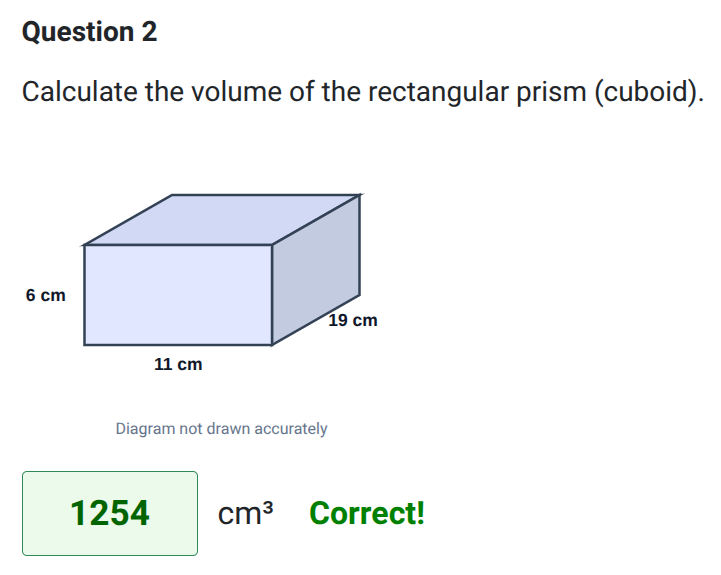
This interactive worksheet generates eight questions to help you practise calculating the volume of various prisms.
The progression starts with a simple given cross-section and builds up to cylinders and a reverse problem where you must find a missing length.
What you’ll practise
- use volume = cross-sectional area × length
- calculate triangular and trapezoidal cross-sectional areas
- calculate volumes of compound prisms
- calculate cylinder volumes using πr²h
Use the interactive worksheet below, or read the Topic guide for the method and worked example.
Volume of a prism
Give all answers to 1 decimal place. For cylinders, use the π button or π = 3.142.
Topic guide
What is a prism?
A prism is a solid 3D shape that has a constant cross-section. This means that if you slice through it parallel to its front face, the shape you see remains exactly the same all the way through.
Key method
To find the volume of any prism, use the formula:
Volume = area of cross-section × length
Finding the cross-sectional area
Depending on the shape of the prism, you must calculate the area of the cross-section first:
- Rectangle: width × height
- Triangle: ½ × base × perpendicular height
- Trapezium: ½(a + b) × perpendicular height
- Compound shape: split into simple rectangles, find their individual areas, and add them together
Cylinders
A cylinder is a prism with a circular cross-section. Since the area of a circle is πr², the formula for the volume of a cylinder is:
V = πr²h
If you are given the diameter of the cylinder, make sure you divide it by 2 to find the radius before substituting it into the formula.
Worked example
Question: Calculate the volume of a triangular prism with a right-angled triangular cross-section. The triangle has a base of 6 cm and a height of 4 cm. The prism has a length of 10 cm.
Step 1: Find the area of the cross-section.
Area of triangle = ½ × base × height
= ½ × 6 × 4
= 12 cm²
Step 2: Multiply by the length of the prism.
Volume = 12 × 10
= 120 cm³
Common mistakes
- Forgetting the ½ when calculating the area of a triangular cross-section.
- Using the diameter instead of the radius in the πr² formula.
- Multiplying all the given numbers together without first identifying the correct cross-section.
- Writing cm² instead of cm³ for the final volume.
- Rounding π or intermediate values too early, which makes the final answer inaccurate. (On this worksheet, answers should be rounded to 1 decimal place at the very end).