
Inequalities
An inequality describes a range of possible values rather than one exact answer. In this worksheet, you will practise interpreting inequality symbols, representing inequalities on number lines, listing integer solutions and solving linear and compound inequalities. Jump to the questions
Practise now
Worksheet preview and key skills
Worksheet preview
The questions progress from interpreting symbols and number lines to listing integer solutions and solving linear and compound inequalities.
What you’ll practise
- interpreting inequality notation
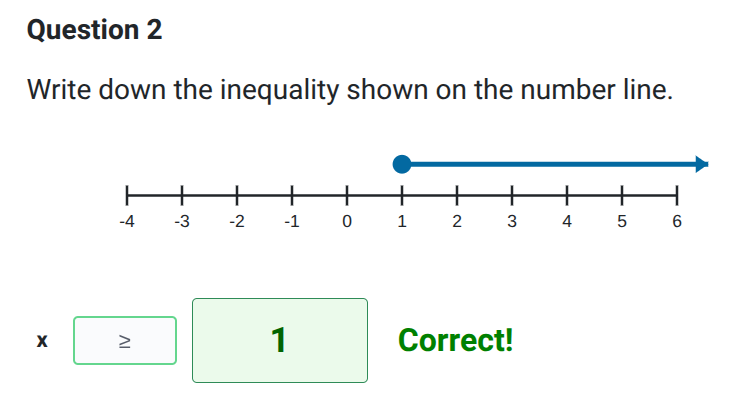
- reading and drawing inequalities on number lines
- listing integer solutions
- solving linear and compound inequalities
Use the interactive worksheet below, or read the Topic guide for the method and worked example.
Inequalities
Practise interpreting inequality notation, reading and drawing number lines, listing integer solutions and solving linear and compound inequalities.
Topic guide
1. What an inequality means
An inequality describes a range of possible values rather than a single exact number. For example, if a ride requires you to be at least 120 cm tall, your height can be 120 cm, 121 cm, 130 cm and so on. We use inequality symbols to write this mathematically.
2. The inequality symbols
<means less than (strict inequality).>means greater than (strict inequality).≤means less than or equal to (inclusive inequality).≥means greater than or equal to (inclusive inequality).
3. Open and closed circles on number lines
We represent inequalities visually on a number line:
- An open circle is used for
<and>. It shows that the value is a boundary, but is not included in the solution. - A closed circle (coloured in) is used for
≤and≥. It shows that the value itself is included in the solution.
4. Reading one-ended inequalities
A one-ended inequality like x > 3 means x can be any number greater than 3. On a number line, this is drawn as an open circle at 3 with an arrow extending to the right.
5. Reading compound inequalities
A compound inequality traps a variable between two values. For example, 2 < y ≤ 5 means y is greater than 2, but less than or equal to 5. On a number line, this is shown as an open circle at 2 and a closed circle at 5, with a solid line joining them together.
6. Listing integer solutions
Integers are whole numbers (positive, negative, and zero). When asked to list the integer solutions to an inequality like -1 ≤ n < 3, you list all the whole numbers in that range. For this example, the integer solutions are -1, 0, 1, 2. We do not include 3 because the inequality is strictly less than 3.
7. Solving linear inequalities
You can solve linear inequalities using the same inverse operations you use for ordinary equations. You aim to isolate the unknown variable on one side. The key difference is that your final answer will be an inequality rather than a single number.
8. Worked example: Solving a two-step inequality
Solve: 3x + 5 ≤ 17
Step 1: Subtract 5 from both sides.
3x ≤ 12
Step 2: Divide both sides by 3.
x ≤ 4
9. Worked example: Solving a compound inequality
Solve: -2 < 2n - 4 ≤ 6, then list the integer solutions.
Step 1: Add 4 to all three parts.
2 < 2n ≤ 10
Step 2: Divide all three parts by 2.
1 < n ≤ 5
The integer solutions are 2, 3, 4, 5.
10. Common mistakes
- Confusing the
<(less than) and>(greater than) symbols. - Using a closed circle when the inequality is strict (
<or>). - Using an open circle when equality is included (
≤or≥). - Missing an endpoint integer when listing solutions (e.g. forgetting to include the boundary value for
≤). - Changing the direction of the inequality sign during ordinary addition or subtraction.
- Forgetting that the inequality sign reverses only when multiplying or dividing both sides by a negative number. Note: Reversing the inequality sign for negative coefficients is an important later extension, but it is not tested in this introductory worksheet.