
Loci
This worksheet provides interactive practice for constructing and identifying loci.
You will use a virtual pair of compasses and straightedge to establish boundaries, from a simple circle exactly 3 m from a point, to complex garden plans involving multiple conditions.
Crucially, you will also practice interpreting inequalities by shading the correct regions defined by those boundaries. Jump to the questions
Practise now
Worksheet preview and key skills
Worksheet preview
This worksheet requires you to construct geometric boundaries and shade regions that satisfy specific criteria. You will use an interactive pair of compasses and ruler.
The progression moves from basic physical distance boundaries up to three-condition contextual problems.
What you’ll practise
- Constructing a locus at a fixed distance from a point or line segment.
- Constructing a locus equidistant from two points or two intersecting lines.
- Understanding the difference between a mathematical boundary and an inequality.
- Shading regions that satisfy multiple simultaneous conditions.
Use the interactive worksheet below, or read the Topic guide for the method and worked example.
Answer the questions below, using the tools provided.
After setting the radius of a circle or arc you MUST draw along the line (it will change from dotted to solid).
Topic guide
A locus (plural: loci) is a set of all points that share a mathematical property or satisfy a specific rule.
Boundaries vs. Regions
The wording of a loci question tells you whether you need to draw a boundary line or shade a region:
- "Exactly 3 m from..." means the locus is the boundary line itself.
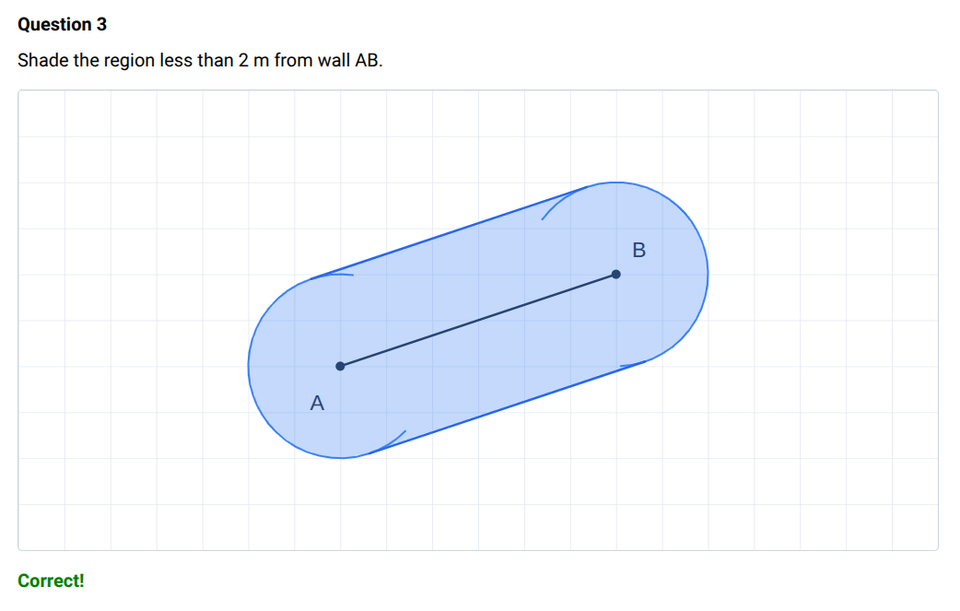
- "Less than 3 m from..." means the locus is the region inside the boundary.
- "More than 3 m from..." means the locus is the region outside the boundary.
Standard Loci
There are four standard locus types you must be able to construct:
- Fixed distance from a point: A circle drawn around the point.
- Equidistant from two points: The perpendicular bisector between the two points.
- Equidistant from two intersecting lines: The angle bisector of the angle between the lines.
- Fixed distance from a line segment: A "capsule" shape consisting of two parallel lines and two semi-circular ends.
Worked example
Question: Shade the region that is closer to tree A than tree B, and less than 4 m from tree A.
Method:
- First, construct the perpendicular bisector between tree A and tree B. This line divides the space into "closer to A" and "closer to B".
- Next, use your compass to draw a circle with a radius of 4 m centred on tree A.
- Finally, identify the region that satisfies both conditions simultaneously. Shade the area that is inside the 4 m circle AND on the side of the bisector containing tree A.
Common mistakes
- Rubbing out construction lines: Always leave your compass arcs visible. They are the evidence that you have used a mathematically accurate method.
- Shading the wrong side: Always double-check your inequality signs. "Less than" usually means inside, while "more than" means outside.
- Square corners on a segment locus: The locus at a fixed distance from a line segment must have perfectly rounded semi-circular ends. Do not draw a rectangle with square corners.