
Bearings
This worksheet provides interactive practice on bearings, covering the fundamental rules and conventions for measuring and drawing them.
You will practise using three-figure notation, measuring bearings clockwise from North, and calculating back bearings.
Crucially, you will also apply these skills to solve problems involving scale drawings, such as locating positions or constructing routes given distances and bearings using a built-in on-screen digital protractor, straightedge ruler, and construction lines. Jump to the questions
Practise now
Worksheet preview and key skills
Worksheet preview
This worksheet provides interactive practice with bearings, from basic conventions up to exam-style problems involving scale diagrams.
The questions begin with measuring and three-figure notation, before moving to reverse bearings and interactive coordinate placement.
What you’ll practise
- Writing bearings using three-figure notation.
- Measuring bearings clockwise from North.
- Calculating back (reverse) bearings.
- Drawing bearings and plotting points on scale diagrams using an on-screen protractor, straightedge ruler, and construction lines.
Use the interactive worksheet below, or read the Topic guide for the core rules and methods.
Bearings
Answer the questions below.
Topic guide
A bearing is an angle used to describe a direction, commonly used in navigation. There are three essential rules for bearings:
- They must be measured from North (represented by an upward-pointing vertical line, usually labelled 'N').
- They must be measured in a clockwise direction.
- They must be written using exactly three figures (e.g., 45° must be written as 045°).
Reverse (Back) Bearings
A back bearing is the bearing to travel in the opposite direction, from your destination back to your starting point.
- If the original bearing is less than 180°, add 180° to find the back bearing.
- If the original bearing is 180° or more, subtract 180° to find the back bearing.
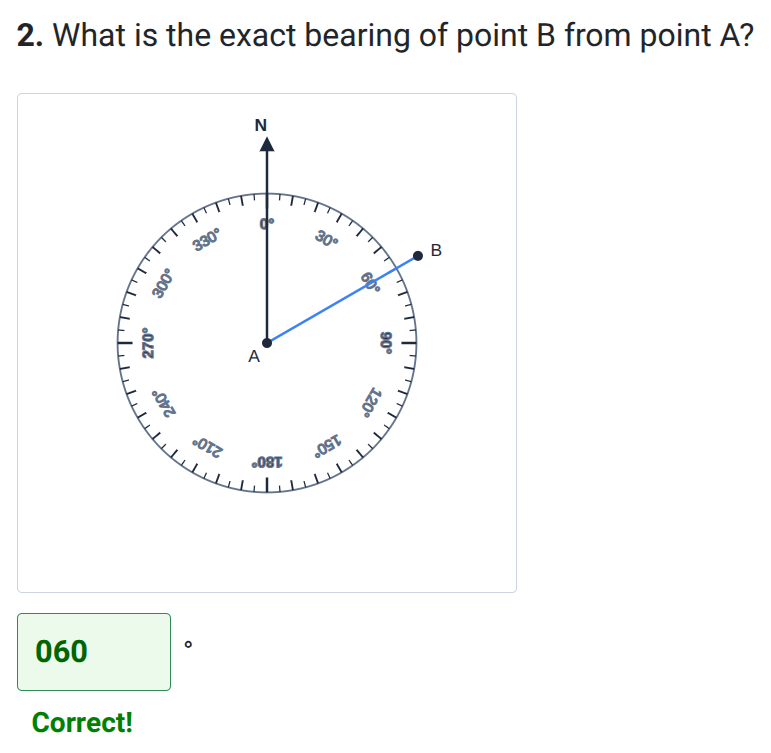
Example: If the bearing of B from A is 060°, the bearing of A from B is 060° + 180° = 240°.
Example: If the bearing of B from A is 295°, the bearing of A from B is 295° - 180° = 115°.
Scale Drawings
Bearings are often used alongside distances on scale diagrams to pinpoint locations.
- Start by drawing a North line at your starting point.
- Use a protractor to measure the given bearing clockwise from the North line.
- Draw a straight construction line in that direction.
- Use a straightedge ruler and the given scale to measure the correct distance along the line and mark your destination point.