
Volume of a Cone
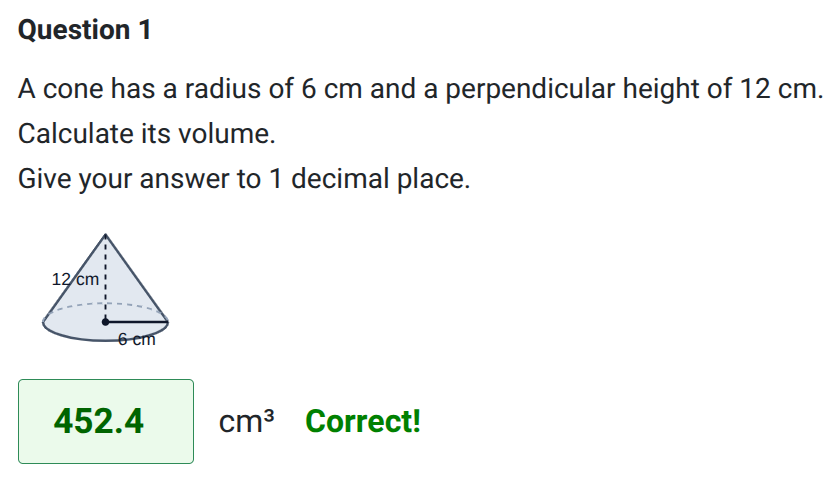
This worksheet practises using the formula for the volume of a cone.
You will need to calculate the volume (1⁄3πr²h) using the radius and perpendicular height. You will also practise using Pythagoras to find the perpendicular height when the slant height is given, and working backwards from a given volume to find missing lengths. Jump to the questions
Practise now
Worksheet preview and key skills
Worksheet preview
This worksheet generates questions on finding the volume of a cone.
The progression moves from straightforward formula substitution towards using Pythagoras, and finishes with finding missing lengths from a known volume.
What you’ll practise
- Calculating the volume of a cone.
- Understanding the difference between radius and diameter.
- Using Pythagoras to find the perpendicular height when the slant height is given.
- Working backwards to find the perpendicular height or radius when the volume is known.
- Giving exact answers in terms of π.
Use the interactive worksheet below, or read the Topic guide for the formula and worked examples.
Volume of a cone
Calculate the volume of the cones, or work backwards to find a missing length.
Topic guide
The formula
To find the volume of a cone, you need to know the radius of the base (r) and the perpendicular height (h).
Volume = 1⁄3 πr²h
Radius, perpendicular height and slant height
It is very important to use the correct measurements:
- Radius (r): The distance from the centre of the circular base to the edge. If you are given the diameter, halve it.
- Perpendicular height (h): The straight vertical distance from the point (apex) to the centre of the base. This is the length used in the volume formula.
- Slant height (l): The distance along the sloping side of the cone. Do not use this directly in the volume formula.
Worked example 1: Finding volume
Find the volume of a cone with radius 4 cm and perpendicular height 9 cm. Give your answer to 1 decimal place.
- Identify the measurements: r = 4, h = 9
- Use the formula: V = 1⁄3 × π × 4² × 9
- Calculate: V = 1⁄3 × π × 16 × 9 = 48π
- Calculate the decimal: 48 × π ≈ 150.796...
- Round to 1 decimal place: 150.8 cm³
Worked example 2: Using Pythagoras
If you are given the slant height (l) instead of the perpendicular height (h), you must use Pythagoras' theorem first.
Find the volume of a cone with radius 5 cm and slant height 13 cm.
- Use Pythagoras to find h: h² = 13² - 5²
- h² = 169 - 25 = 144
- h = √144 = 12 cm
- Now use the volume formula: V = 1⁄3 × π × 5² × 12 = 1⁄3 × π × 25 × 12 = 100π cm³
Exact answers in terms of π
Sometimes you will be asked to give your answer "in terms of π". This means you do not multiply by 3.142. Instead, you leave π in your final answer, exactly as shown in the examples above (e.g. 48π or 100π).
Reverse problems (working backwards)
You may be given the numerical volume and asked to find the perpendicular height or radius.
Example: The volume of a cone is 300 cm³. Its radius is 5 cm. Find the perpendicular height.
- Write the equation: 1⁄3π × 5² × h = 300
- Simplify: 25⁄3π × h = 300
- Multiply by 3: 25π × h = 900
- Divide by 25π: h = 900 ÷ (25π) ≈ 11.5 cm
Common mistakes
- Using the slant height: Make sure you always use the perpendicular height (h) in the formula. Use Pythagoras to find it if necessary.
- Forgetting the 1⁄3: A cone has one-third the volume of a cylinder with the same base and height.
- Using the diameter: Always halve the diameter first to find the radius.
- Forgetting to square the radius: Ensure you calculate r² correctly.