
Lowest Common Multiple (LCM)
The lowest common multiple (LCM) is the smallest positive whole number that is a multiple of every number in a given set. It is especially useful for solving real-world problems involving events that begin together and repeat at different intervals, or finding the smallest equal number of items when objects are grouped in different sizes. Jump to the questions
Practise now
Worksheet preview and key skills
Worksheet preview
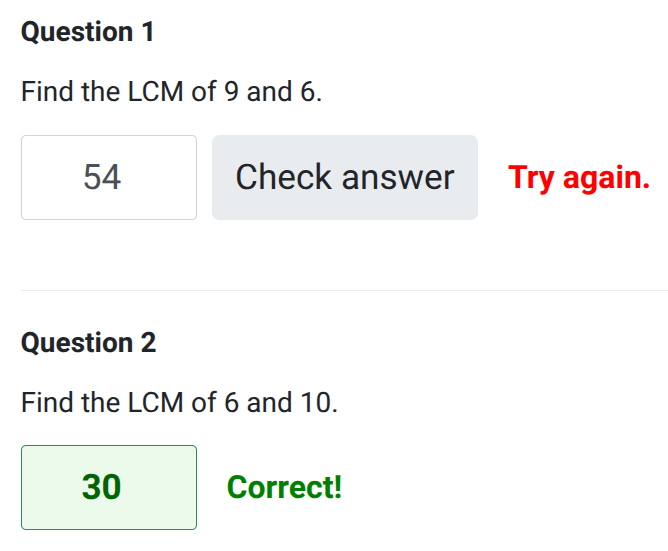
This worksheet helps you practise finding the lowest common multiple (LCM) of different sets of numbers. You will work through simple pairs before progressing to larger numbers and worded problems.
The self-marking activity includes questions with two numbers, three numbers, and real-life scenarios to test your understanding of what the lowest common multiple actually represents.
What you’ll practise
- Finding the LCM of straightforward number pairs
- Recognising when one number divides exactly into the other
- Understanding that when numbers share no other factors, their LCM is their product
- Finding the LCM of three numbers
- Using the lowest common multiple to solve recurring-event and equal-grouping problems
Use the interactive worksheet below, or read the Topic guide for the method and worked example.
Lowest common multiple
Find the lowest common multiple of each set of numbers, or use the lowest common multiple to solve each problem.
Topic guide
What is a multiple?
A multiple is the result of multiplying a number by a whole number. You can think of multiples as the numbers in that number's times table. For example, the multiples of 4 are 4, 8, 12, 16, 20 and so on.
What is a common multiple?
When you compare the lists of multiples of two or more numbers, any numbers that appear in all lists are called common multiples. For example, the common multiples of 4 and 6 are 12, 24, 36 and so on.
What is the lowest common multiple?
The lowest common multiple (LCM) is the smallest positive whole number that appears in all the lists. Looking at our common multiples of 4 and 6 (which were 12, 24, 36...), the smallest is 12. So, the LCM of 4 and 6 is 12.
A method using lists of multiples
For most numbers, the most reliable mental or written method is to list out the multiples of the larger number first, and check if each one is also a multiple of the smaller number.
Worked example: Find the LCM of 6 and 8
First, list the multiples of the larger number (8):
- 8 (not a multiple of 6)
- 16 (not a multiple of 6)
- 24 (this is a multiple of 6!)
Because 24 is the first number in the 8 times table that is also in the 6 times table, the LCM of 6 and 8 is 24.
Finding the LCM of three numbers
The method is similar for three numbers. For example, to find the LCM of 4, 6 and 10, start by listing the multiples of the largest number (10):
- 10, 20, 30, 40, 50 (none of these divide exactly by both 4 and 6)
- 60 (60 divides exactly by 4 to give 15, and by 6 to give 10)
So, the LCM of 4, 6 and 10 is 60.
The special case: one number divides the other
Sometimes, the smaller number divides exactly into the larger number. For example, with 7 and 28, 7 divides exactly into 28. In this case, the larger number itself (28) is the lowest common multiple.
What does it mean when the numbers share no common factors?
If two numbers share no common factors other than 1 (for example, 5 and 8), you will find their LCM by simply multiplying them together. The LCM of 5 and 8 is 5 × 8 = 40.
Alternative method for larger numbers
For larger numbers, you can use prime factorisation (drawing factor trees and using Venn diagrams) to find the LCM. That method is covered in a separate topic.
Recognising LCM word problems
In worded problems, you might not be told explicitly to "find the LCM". You must recognise when it is required. Look out for situations involving:
- Recurring events: Things that happen at different intervals (like flashing lights or buses departing) and you need to find when they will next happen at the same time.
- Equal grouping: People arranging different-sized sets of items and you need to find the smallest equal number of items they could each have.
Common mistakes
- Confusing the lowest common multiple (LCM) with the highest common factor (HCF).
- Choosing a common multiple that is not the lowest one (for example, saying the LCM of 6 and 8 is 48 instead of 24).
- Automatically multiplying the two numbers together when they share a factor (for example, saying the LCM of 4 and 6 is 24 instead of 12).
- Treating 0 as the required LCM rather than using the smallest positive common multiple.
- Stopping a multiples list too early before reaching the first shared value.