
Error Intervals
This worksheet helps you practise finding lower and upper limits to write complete error intervals. You will learn to choose the correct inequality symbols, and you will see how the method changes when a value is truncated instead of rounded. Jump to the questions
Practise now
Worksheet preview and key skills
Worksheet preview
This worksheet helps you build a strong understanding of how to find the original range of possible values when a number has been rounded or truncated.
The self-marking activity progresses from finding simple upper and lower bounds to writing complete error intervals using inequality symbols. You will practise with different levels of accuracy, including decimal places and significant figures.
What you’ll practise
- Finding lower and upper limits for numbers rounded to the nearest whole number or power of ten
- Finding limits for numbers rounded to decimal places or significant figures
- Finding limits for truncated values
- Choosing the correct inequality symbols for a full error interval
- Applying error intervals to a real-life perimeter problem
Use the interactive worksheet below, or read the Topic guide for the method and worked example.
Error intervals
Practise finding lower and upper limits, choosing inequality symbols and writing error intervals for rounded and truncated values.
Topic guide
When a measurement or number is rounded or truncated, we lose its exact original value. An error interval shows the full range of possible values the original number could have been.
Lower and upper limits
The lower limit is the smallest value that would round or truncate to the stated number.
The upper limit is the boundary for the largest possible values. It is the first value that would round or truncate to the next number up.
The standard inequality notation
We write error intervals using this format:
lower limit ≤ x < upper limit
- The lower limit uses ≤ (less than or equal to) because the exact lower limit is included. For example, 4.5 rounds up to 5, so 4.5 is in the interval.
- The upper limit uses < (strictly less than) because the upper limit itself is excluded. For example, 5.5 rounds up to 6, not 5, so the original number must be strictly less than 5.5.
Method for rounded values
To find the limits when a number has been rounded:
- Identify the unit of accuracy (e.g. 10, 0.1, 0.01).
- Halve this unit.
- Subtract the half-unit from the rounded value to get the lower limit.
- Add the half-unit to the rounded value to get the upper limit.
Worked example: nearest whole number
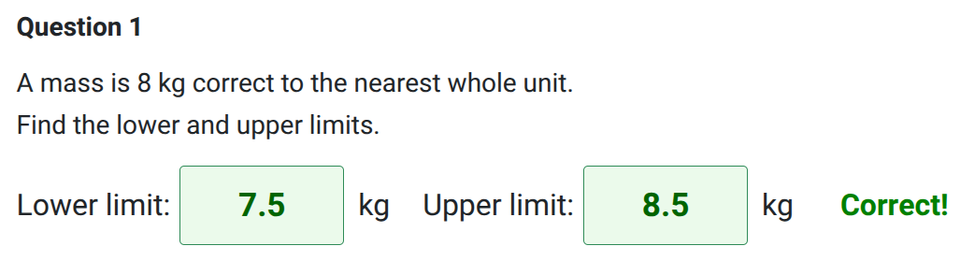
A length x is 7 cm correct to the nearest whole number. Find the error interval.
The accuracy is 1 cm. Half of 1 cm is 0.5 cm.
- Lower limit = 7 − 0.5 = 6.5
- Upper limit = 7 + 0.5 = 7.5
Error interval: 6.5 ≤ x < 7.5
Worked example: decimal places
A mass y is 3.4 kg correct to 1 decimal place. Find the error interval.
The accuracy is 0.1. Half of 0.1 is 0.05.
- Lower limit = 3.4 − 0.05 = 3.35
- Upper limit = 3.4 + 0.05 = 3.45
Error interval: 3.35 ≤ y < 3.45
Method for significant figures
First, identify the place value of the final significant figure. Always count from the first non-zero digit to find which place value the final significant figure represents.
Worked example: significant figures
A distance d is 450 m correct to 2 significant figures. Find the error interval.
The 4 is the first significant figure (hundreds). The 5 is the second significant figure (tens). The place value of the final significant figure is 10. Half of 10 is 5.
- Lower limit = 450 − 5 = 445
- Upper limit = 450 + 5 = 455
Error interval: 445 ≤ d < 455
Method for truncated values
Truncating means chopping off the extra digits without rounding up. This changes the method completely.
- The lower limit is always exactly the truncated value displayed.
- The upper limit is found by adding one complete unit of accuracy to the lower limit.
Worked example: truncation
A number x is truncated to 1 decimal place. The result is 8.2. Find the error interval.
- Lower limit = 8.2
- Upper limit = 8.2 + 0.1 = 8.3
Error interval: 8.2 ≤ x < 8.3
Applied perimeter intervals
To find the error interval for the perimeter of a regular polygon, first find the lower and upper limits of a single side. Then multiply both limits by the number of sides. The inequality symbols remain ≤ and <.
Common mistakes
- Including the upper limit with ≤ – Remember that the upper limit itself rounds up, so the original value must be strictly less than (<) the upper limit.
- Using < at the lower limit – The exact lower limit is always included, so it must be ≤.
- Subtracting and adding the full rounding unit – For rounded values, you must add and subtract half of the accuracy unit, not the full unit.
- Using the rounding method for a truncated value – Truncated values do not go down by half a unit. The displayed value is the lowest it can be.
- Identifying the wrong place value in a significant-figures question – Always count from the first non-zero digit to find which place value the final significant figure represents.
- Losing meaningful trailing zeros – If a number is 5.0 to 1 decimal place, the zero shows the accuracy. The limits are 4.95 and 5.05.
- Typing the rounded value as one or both limits – The error interval describes the range of original values, not the final rounded answer.
- Confusing the upper limit with the largest possible actual value – The upper limit is a strict boundary, not an attainable maximum. You cannot write a terminating decimal like 5.4999... as the upper limit.
Recap
For rounded values, find half the accuracy unit, then subtract and add it. For truncated values, the lower limit is the number itself, and the upper limit is one full unit higher.