
Metric capacity conversions
Understanding how to convert metric units for capacity is essential in everyday life, from measuring ingredients in a recipe to understanding the volume of a water bottle or fuel tank. Whether you're working with milliliters, liters, or kiloliters, knowing how to switch between these units helps in science, cooking, and even shopping for liquids! Jump to the questions
Jump to the questions
Worksheet preview and key skills
Worksheet preview
Practise metric capacity conversions with this self-marking maths worksheet.
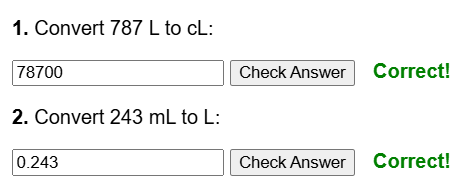
The interactive worksheet below generates questions, gives instant feedback, and lets students record their score.
What you’ll practise
- Converting between ml and litres where relevant.
- Choosing the correct conversion factor.
- Multiplying or dividing by powers of 10.
- Keeping the correct capacity unit in the answer.
Use the interactive worksheet below, or read the Topic guide for the method and worked example.
Convert the following values to the required units.
Topic guide
What this worksheet practises
This worksheet focuses on converting between different metric units of capacity (volume), specifically millilitres (ml) and litres (L). This is a vital everyday skill used in cooking, science, and measuring liquids.
Key method
The metric system is based on powers of 10. For capacity, the magic number is 1000.
- There are exactly 1000 millilitres (ml) in 1 Litre (L).
- To convert Litres to millilitres (Large to small unit): Multiply by 1000. This means moving the decimal point three places to the right.
- To convert millilitres to Litres (Small to large unit): Divide by 1000. This means moving the decimal point three places to the left.
Worked example
1) Convert 4.2 Litres into millilitres.
2) Convert 850 millilitres into Litres.
Step 1 (L to ml): We are going from a large unit to a small unit, so we multiply by 1000.
4.2 × 1000.
Move the decimal three places right: 4200.
Answer: 4200 ml.
Step 2 (ml to L): We are going from a small unit to a large unit, so we divide by 1000.
850 ÷ 1000.
Move the decimal three places left (starting from the end of 850.0): 0.850.
Answer: 0.85 Litres.
Common mistakes to avoid
The most common error is multiplying when you should divide, or dividing when you should multiply. Remember: a litre is much bigger than a millilitre. If you pour a bottle of water (litres) into tiny thimbles (millilitres), you will have a huge number of thimbles. Therefore, Litres to ml always creates a much larger number.
Things to remember
The prefix "milli" literally means "one-thousandth". Therefore, a millilitre is one-thousandth of a litre. The same prefix rule applies to length: a millimetre is one-thousandth of a metre.