
Order of operations - BIDMAS
Order of operations is like the rulebook for solving maths problems the right way. Just like a recipe tells you whether to mix or bake first, the order of operations tells you what to calculate first so that everyone gets the same answer—even when the problem looks complicated! Jump to the questions
Practise now
Worksheet preview and key skills
Worksheet preview
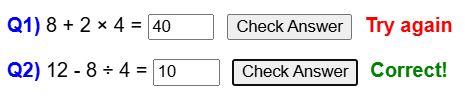
Practise the order of operations (BIDMAS) with this self-marking maths worksheet.
The interactive worksheet below generates questions, gives instant feedback, and lets students record their score.
What you’ll practise
- Applying BIDMAS or order of operations.
- Dealing with brackets first.
- Completing powers, multiplication, division, addition and subtraction in the correct order.
- Avoiding left-to-right mistakes where operations have different priority.
Use the interactive worksheet below, or read the Topic guide for the method and worked example.
Topic guide
What this worksheet practises
This worksheet provides practice on the Order of Operations, universally remembered by the acronym BIDMAS (or BODMAS). It dictates the strict mathematical sequence you must follow when calculating an expression that has multiple different operations (like plus, multiply, and brackets) mixed together.
Key method
You must perform the calculations in this exact order:
- B (Brackets): Calculate whatever is inside the brackets first.
- I (Indices): Calculate any powers or square roots next (e.g. 3²).
- D & M (Division & Multiplication): Do these next. They are equally important, so if both are present, simply work from left to right.
- A & S (Addition & Subtraction): Do these last. Again, they are equally important, so work from left to right.
Worked example
Calculate 5 + 3 × (8 − 2)².
Step 1 (Brackets): Calculate (8 − 2) first.
The sum becomes: 5 + 3 × 6².
Step 2 (Indices): Calculate the 6².
The sum becomes: 5 + 3 × 36.
Step 3 (Multiplication): Calculate 3 × 36. (Do not do 5 + 3).
The sum becomes: 5 + 108.
Step 4 (Addition): Finally, add the remaining numbers.
The final answer is 113.
Common mistakes to avoid
The most common and natural mistake is simply reading the calculation like a book, from left to right, ignoring the hierarchy completely. For example, calculating 2 + 5 × 3 by doing (2 + 5) = 7, then 7 × 3 = 21. Because multiplication happens before addition, the correct calculation is 5 × 3 = 15, then 2 + 15 = 17.
Things to remember
A long fraction line acts like an invisible set of brackets. If you see a complicated sum on top of a fraction line, and a complicated sum on the bottom, you must calculate the entire top, then the entire bottom, before you finally perform the division.