
Pythagoras in surd form
When calculating the distance between two points – whether it’s across a field, up a ladder, or even in a video game – Pythagoras’ Theorem is your go-to tool. But sometimes the answer isn’t a neat whole number. That’s where surds come in: they let us leave square roots in their exact form, keeping your answers precise without reaching for a calculator. Jump to the questions
Practise now
Worksheet preview and key skills
Worksheet preview
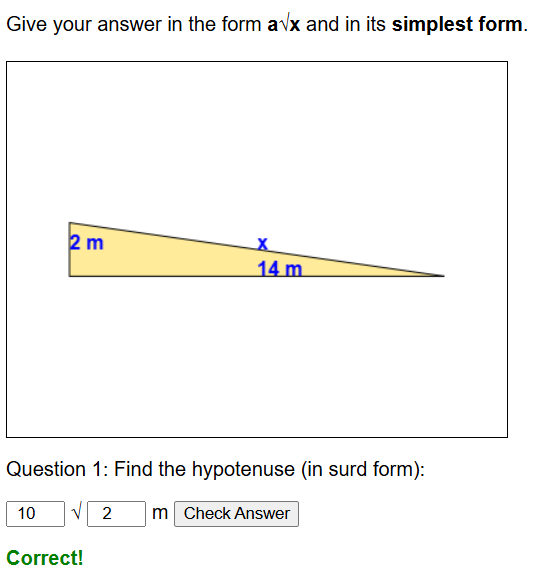
Practise Pythagoras in surd form with this self-marking maths worksheet.
The interactive worksheet below generates questions, gives instant feedback, and lets students record their score.
What you’ll practise
- Using Pythagoras’ theorem exactly.
- Leaving the square root in surd form.
- Simplifying surds where possible.
- Avoiding unnecessary decimal rounding.
Use the interactive worksheet below, or read the Topic guide for the method and worked example.
Give your answer in the form a√b and in its simplest form.
Topic guide
What this worksheet practises
This worksheet provides practice on using Pythagoras' Theorem where the final answer must be left as a "surd" (an exact square root like √45) rather than a rounded decimal. This is extremely common in non-calculator exams.
Key method
The Pythagoras method is exactly the same, you just skip the very last calculator step and simplify the surd instead.
- Identify your sides: 'a' and 'b' are the short sides, 'c' is the hypotenuse (the longest side, opposite the right angle).
- Use the formula: a² + b² = c² (to find the hypotenuse) or c² − b² = a² (to find a short side).
- Once you have a value for a² or c², put a square root symbol over the number. E.g. c = √50.
- Simplify the Surd: Look for the largest square number (4, 9, 16, 25, 36...) that divides exactly into your number. Split the root and simplify it.
Worked example
A right-angled triangle has short sides of 5cm and 5cm. Find the exact length of the hypotenuse in simplified surd form.
Step 1: Set up the formula. We need 'c'.
5² + 5² = c²
25 + 25 = c²
50 = c²
Step 2: Put it in a root.
c = √50.
Step 3: Simplify the surd. The largest square number that goes into 50 is 25.
√50 = √(25 × 2)
√50 = √25 × √2
c = 5√2.
The exact length is 5√2 cm.
Common mistakes to avoid
A common error is stopping at √50 and failing to simplify it to 5√2. If the question specifically asks for "simplified surd form" or "the form a√b", stopping early will cost you the final method mark.
Things to remember
If you perform your calculation and get a number like c² = 17, and you cannot find any square number that divides into 17 (because 17 is prime), then your final answer is simply √17. Not all surds can be simplified.