
Area of a trapezium / trapezoid
Trapezium? Trapezoid? You might not realise it but - regardless of which country you're from - the area of this polygon comes in handy more often than you'd think—like when calculating the surface of a sloped roof or the shape of a skate ramp. Trapeziums pop up in design, engineering, and architecture, so learning how to find their area is a clever bit of maths with real-world power! Jump to the questions
Practise now
Worksheet preview and key skills
Worksheet preview
Practise area of a trapezium with this self-marking maths worksheet.
The interactive worksheet below generates questions, gives instant feedback, and lets students record their score.
What you’ll practise
- Identifying the two parallel sides.
- Identifying the perpendicular height.
- Using area = 1/2 × (a + b) × h.
- Giving the answer in square units.
Use the interactive worksheet below, or read the Topic guide for the method and worked example.
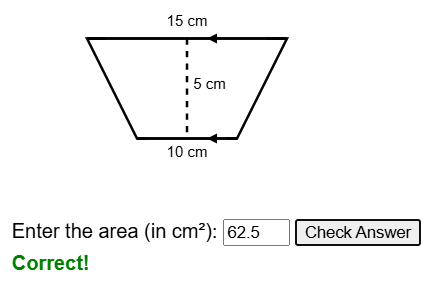
Calculate the area of each trapezium/trapezoid below.
Topic guide
What this worksheet practises
This worksheet provides practice on calculating the area of a trapezium. This is a common shape in geometry problems and real-world applications. A trapezium is a quadrilateral with exactly one pair of parallel sides. Understanding how to find its area is a key progression from finding the area of simpler shapes like rectangles and triangles.
Key method
The standard formula for the area of a trapezium is: Area = ½(a + b)h, where 'a' and 'b' are the lengths of the parallel sides, and 'h' is the perpendicular height between them.
- Identify the two parallel sides. These are 'a' and 'b'.
- Identify the perpendicular height 'h'. Ensure it is at a right angle (90 degrees) to the parallel sides, not a slanted edge.
- Add the lengths of the parallel sides together first.
- Multiply that sum by the height.
- Finally, halve the result.
Worked example
Find the area of a trapezium with parallel sides of 6 cm and 10 cm, and a perpendicular height of 4 cm.
Step 1: Write out the formula and substitute your values.
Area = ½(6 + 10) × 4
Step 2: Calculate the brackets first.
6 + 10 = 16
Step 3: Multiply by the height.
16 × 4 = 64
Step 4: Halve the result.
½ of 64 = 32
The area is 32 cm².
Common mistakes to avoid
A very common mistake is using the slanted side length instead of the perpendicular height. Always look for the line that forms a right angle with the parallel base. Additionally, remember the order of operations: you must add the parallel sides together before multiplying by the height.
How to check your answer
Think about the area of rectangles. If your trapezium has bases of 6 and 10, the "average" width is 8. A rectangle of width 8 and height 4 would have an area of 32, which matches our calculation. If your answer is wildly different, check your steps.