
Perimeter of rectangles with mixed metric units
Working out the perimeter of a rectangle is simple—just add up the lengths of all the sides! But in real life, you might be measuring one side in centimetres and another in metres (like the length of a classroom versus the width of a table). That’s why it’s important to be confident converting between metric units while calculating perimeter. Jump to the questions
Practise now
Worksheet preview and key skills
Worksheet preview
Practise perimeter of rectangles with mixed metric units with this self-marking maths worksheet.
The interactive worksheet below generates questions, gives instant feedback, and lets students record their score.
What you’ll practise
- Converting mixed metric units before calculating.
- Using consistent units for all side lengths.
- Finding the perimeter of the rectangle.
- Giving the final answer with the correct unit.
Use the interactive worksheet below, or read the Topic guide for the method and worked example.
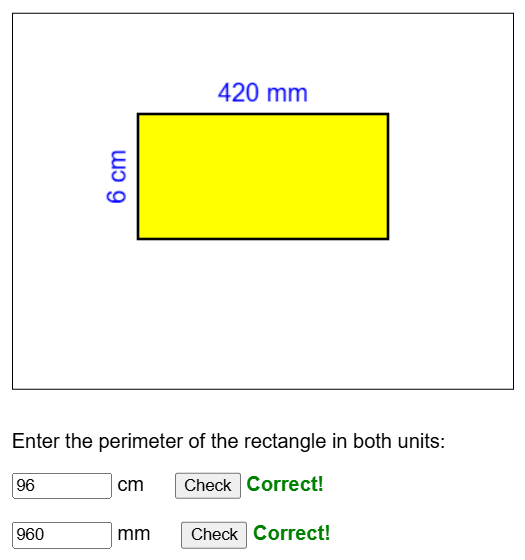
Each rectangle has two dimensions given in different units. Enter the perimeter in both units.
Topic guide
What this worksheet practises
This worksheet focuses on calculating the perimeter of rectangles when the sides are given in different metric units (for example, a base in cm and a height in mm). You cannot perform any calculations until all numbers are in the exact same unit.
Key method
First convert, then calculate.
- Identify the different units in the question (e.g. mm, cm, m).
- Decide which unit you want your final answer to be in. Often, the question will tell you. If it doesn't, it is usually easiest to convert the larger unit into the smaller unit to avoid working with decimals.
- cm to mm: Multiply by 10.
- m to cm: Multiply by 100.
- Once all sides are in the same unit, calculate the perimeter normally by adding all four sides together.
Worked example
A rectangle has a base of 2m and a height of 45cm. Calculate its perimeter in cm.
Step 1: Convert the base from metres to centimetres so all units match.
2m × 100 = 200cm.
Step 2: Note the four sides of the rectangle.
Base = 200cm. Height = 45cm. Opposite base = 200cm. Opposite height = 45cm.
Step 3: Add all four sides together.
200 + 45 + 200 + 45 = 490.
The perimeter is 490cm.
Common mistakes to avoid
The most catastrophic mistake is ignoring the units entirely and just adding the given numbers together (e.g. 2 + 45 + 2 + 45 = 94). A perimeter of 94 is nonsensical if one side alone is 2 metres long. Always check the units before you begin any geometry calculation.
How to check your answer
If you calculated the answer in centimetres, try converting the numbers the other way and calculating it in metres. 45cm is 0.45m. The perimeter would be 2 + 0.45 + 2 + 0.45 = 4.9m. Does 4.9m equal 490cm? Yes (4.9 × 100 = 490). The answer is correct.